
Short answer: A retail car park earns and flows well when entry, payment and exit are matched to the traffic. Choose ticket and pay station, ANPR pay by plate or a mix, then pick barriers, loops and lanes to suit it. Most lost revenue comes from tailgating, lost tickets and unclear validation rules, not from the barrier itself, so plan those first.
In short
- Choose the payment method first: ticket and pay station, ANPR, or a mix.
- Match the barrier to the lane: boom arm, sliding barrier or swing barrier.
- Plan queue space at the entry so traffic does not back onto the road.
- Most revenue leaks are tailgating, lost tickets and vague validation rules.
- Plan for power cuts and fire alarms: the barrier must lift and leave a safe route.
What decides revenue and flow in a retail car park?
Three things: how a car is identified at entry, how payment happens, and how quickly the exit barrier lifts. If entry is slow, queues back up onto the road and the retailer loses visits. If payment is awkward, drivers abandon tickets or argue at the exit. If the exit is unclear, staff spend their day at the barrier.
Retail sites in places like Dubai Festival City, City Walk, Dubai Hills Estate and Al Quoz have different traffic: a weekend peak, many first time visitors, and often validation by shops. The car park has to cope with all of that, in 40 degree summer heat and sometimes in a basement with limited height. Our short answers on what a parking management system is and how to choose one set out the building blocks.
What does the customer journey look like?
The journey has six steps, and each has equipment behind it. Walk through it with your operator and write down who handles each step.
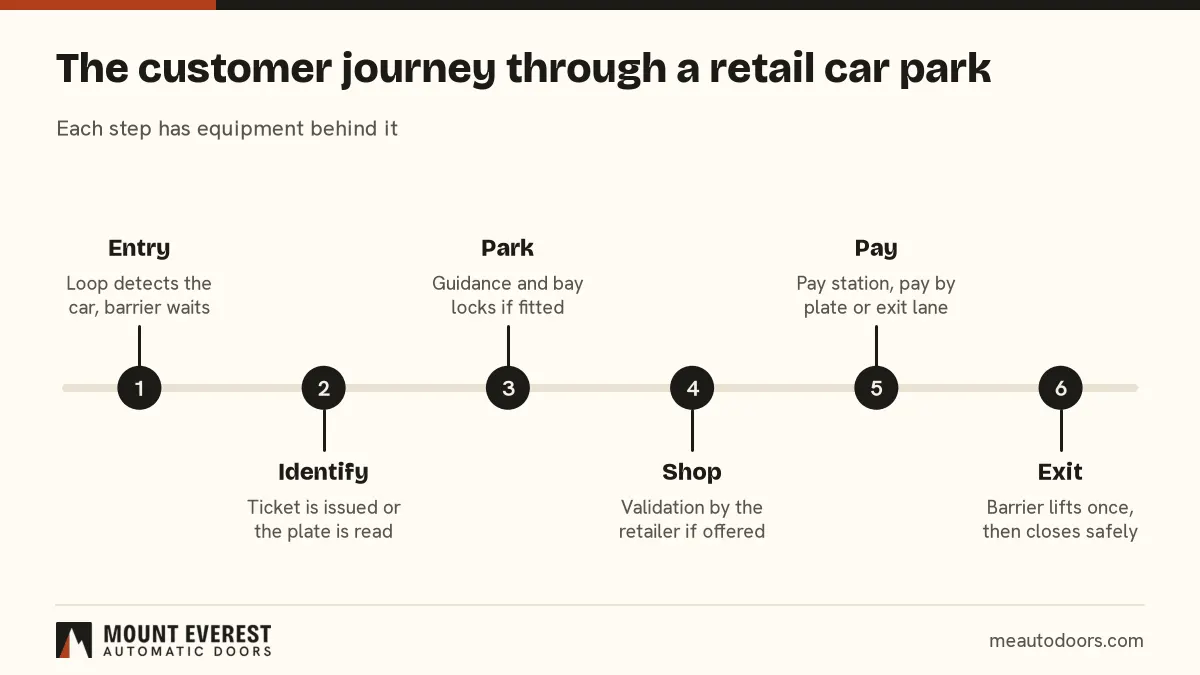
Journey step, equipment and what to check
| Step | Typical equipment | What to check |
|---|---|---|
| Entry | Loop detector, ticket dispenser or camera, entry barrier | Queue space, dispenser height for cars and vans |
| Identify | Ticket issued, or plate read | Plate camera angle and lighting, ticket paper in humidity |
| Park | Guidance signs, bay locks if used | Where drivers circle and where they get lost |
| Validate | Retailer validation or a free period | Clear rules, written down and set in the system |
| Pay | Pay station, pay by plate, or exit lane | Pay stations out of direct sun, enough for peak hours |
| Exit | Exit loop, safety beam, exit barrier | One car per release, barrier closes safely |
Ticket and pay station, ANPR or a mix: which should you choose?
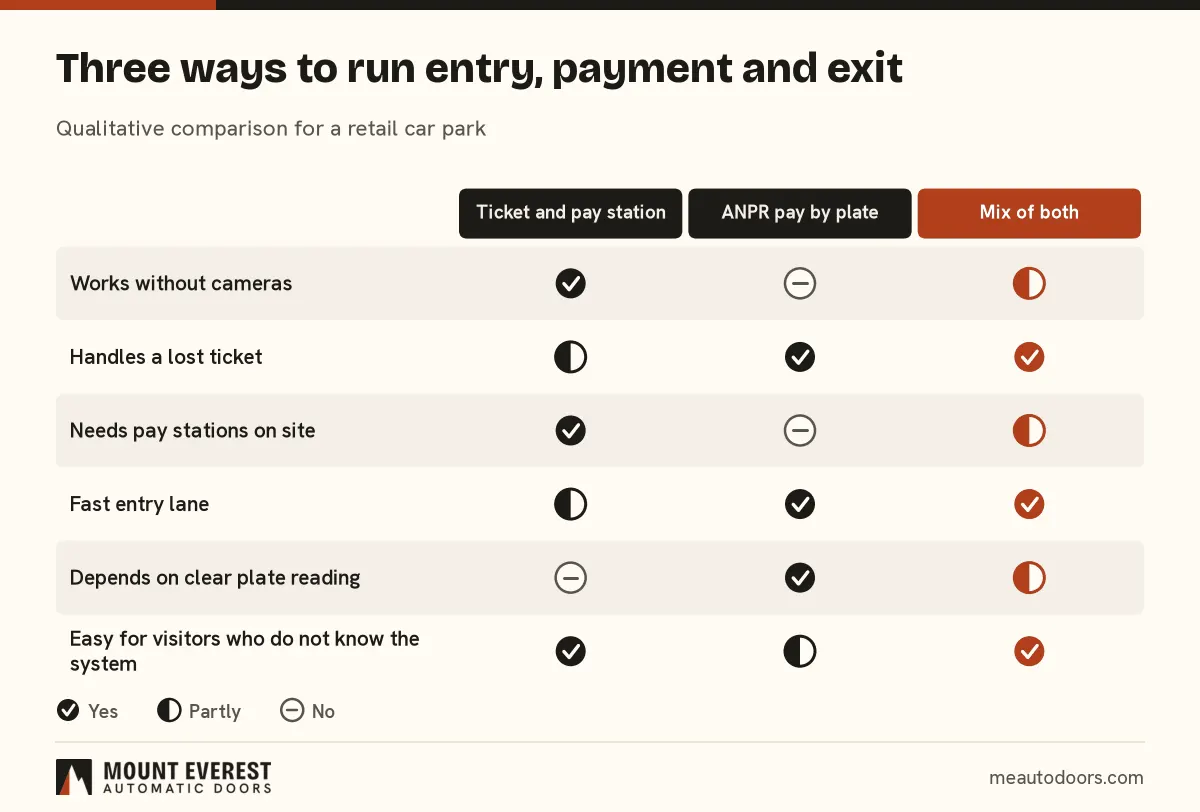
A ticket and pay station suits a site where visitors are many and unfamiliar. ANPR pay by plate suits a site that wants a fast entry and exit and has good camera positions. A mix suits most retail sites because it covers lost tickets and plate misreads.
ANPR reads the plate and links it to the visit. It removes the ticket but depends on a clear plate image. Our answers on what ANPR is and how it helps in a car park and what affects ANPR accuracy explain the points to check: angle, light, speed, dirt and plate type. The ANPR parking systems page lists the service.
Payment hardware and software are a package. The pay station, the ticket or plate record and the barrier must share one data set. Ask whether the system can tell an operator which cars are inside, which have paid and which have left. Card payments use the operator's own payment provider, so confirm that part with the provider and the bank. Our parking management systems page lists what we cover, and we agree the exact scope after a survey.
Which barrier suits which lane?
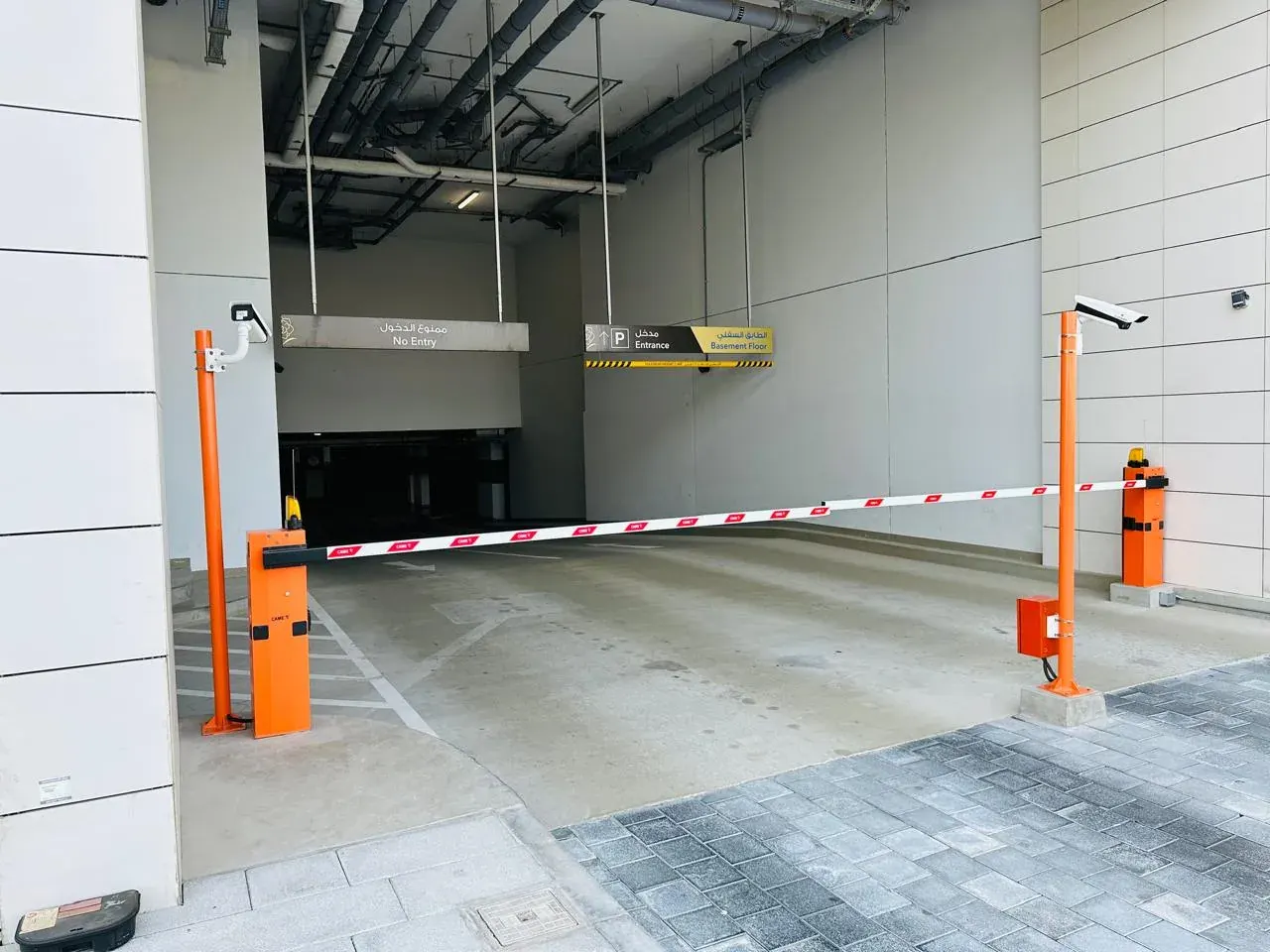
A boom barrier suits most entry and exit lanes. A sliding barrier suits low canopies and narrow sides. A swing barrier suits pedestrian or compact lanes. The choice follows lane width, headroom, traffic and the look of the entrance.
- Boom barrier. The default for car lanes. See the short answer on the right boom barrier for a Dubai parking entrance and our boom barrier page.
- Sliding barrier. Useful where the ceiling is low or a long boom cannot swing. See our comparison of boom barrier and sliding gate for parking.
- Swing barrier. Common for pedestrian lanes and small vehicle entries. See swing gate barriers in Dubai.
- Bollards and bay locks. For reserved bays and to protect pedestrian zones, see bollards and parking locks.
For the equipment itself, see sliding barriers and swing gate barriers. We service barriers from brands such as CAME and FAAC.
How do you lay out the lanes so traffic does not queue?
Give the entry enough queue space before the barrier, so cars wait inside the site, not on the road. Space is measured in car lengths, and it depends on how fast the dispenser or camera and the barrier work, and on the peak arrival rate. Put the ticket dispenser at a height that suits cars, and a second one for vans and SUVs if the site expects them. Keep a clear sight line so drivers see the barrier and the signs.
- Count the entry and exit lanes at peak against the likely arrival and departure rate.
- Consider a reversible lane if weekday and weekend peaks differ.
- Place pay stations before the exit, so cars do not stop at the barrier to pay.
- Fit a loop and a safety beam at each barrier, so the arm does not come down on a car. See what a loop detector does at a barrier and our loop detectors page.
- Add an intercom or help point in each lane for a driver who is stuck.
Where does parking revenue leak?
Revenue leaks at the points where identification, payment and exit do not line up. Look at these five first, before blaming the barrier.
- Tailgating. A second car follows the first through an open barrier. A loop and a safety beam, and a barrier that closes promptly, reduce it.
- Lost or passed back tickets. A ticket handed to the next car. A system that records entry and exit time for each ticket catches repeats.
- Validation set wrongly. A free period set too long, or retailer validation that does not expire. Write rules down and test them.
- Barrier forced or lifted by hand. Often a sign of a slow barrier or a long queue. Check why drivers lose patience.
- Weak reports. If the operator cannot see cars in, cars paid and cars out, errors hide in the gaps.
What happens in a power cut or a fire alarm?
The barrier must lift and stay up, so cars can leave. Fire and emergency behaviour follow the building's fire strategy and the authority, so confirm it with the consultant or the management. Ask what happens to pay stations and plate cameras during a blackout, and how the system records cars that left without paying. A battery backup helps the barrier lift once, and a plan is needed for the cars that remain. See our guide to smart parking management systems in Dubai.
Heat and dust matter too. Pay station screens in direct sun can wash out and overheat, and printers can jam in humid air. Put equipment in shade where possible, check ventilation, and clean camera lenses on a schedule.
What to send us
- A site plan or sketch of the entry, exit and ramps, and photos of each lane.
- The number of entry and exit lanes and the headroom at the barrier.
- The payment method you want: ticket, ANPR or both.
- Whether you have validation by shops, and the rules.
- Any existing barrier, reader or pay station brand and model.
- Peak times, and where queues form today.
- Fire alarm and power supply details for the car park.
How does a visit with Mount Everest work?
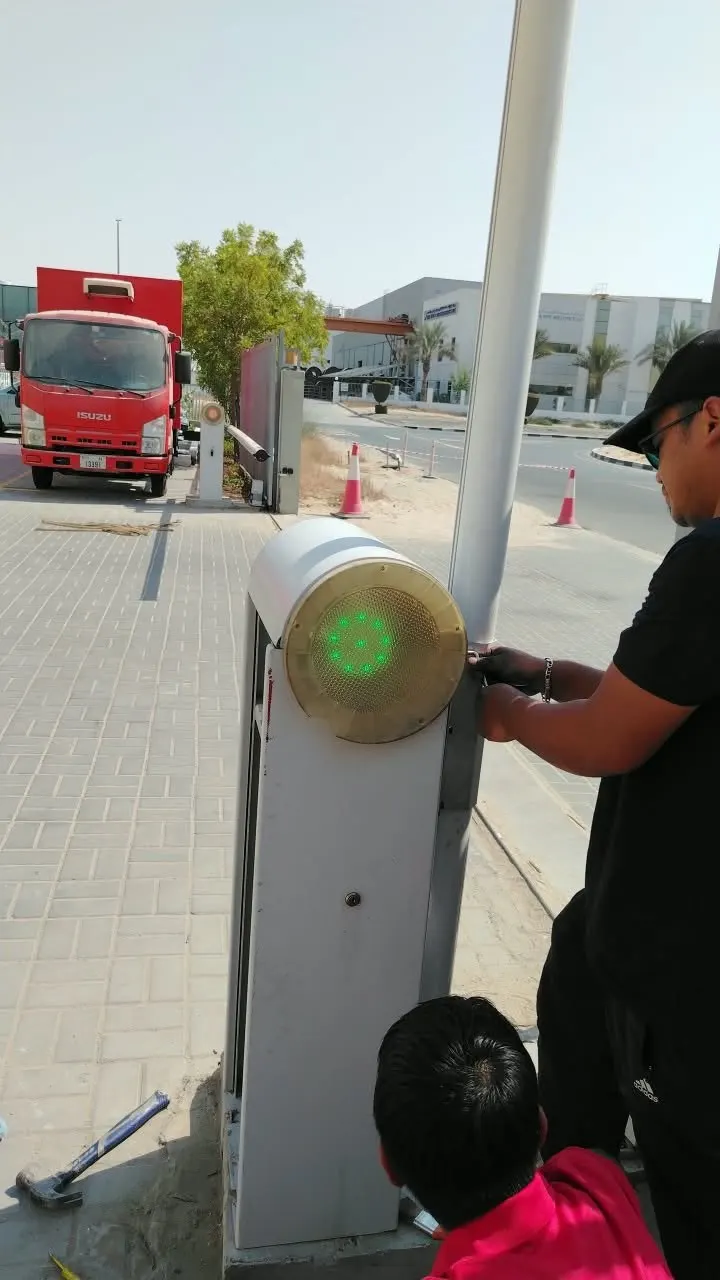
Mount Everest Automatic Doors is an installer and service company. We do not manufacture the barriers, cameras or pay equipment we fit. Our base is in Al Quoz, Dubai. We survey the lanes, watch the entry at a busy time if the site allows, and propose barrier, loop and detection layouts. We agree the scope for the payment side after the survey, give a written quote, and run repeated cycles before handover.
See a recent job: the gate barrier installation in Dubai Hills, where the record describes a barrier at a basement car park ramp. For a repair view, see the gate barrier repair in DIP 1. Read parking management installation in Dubai for how we cover the city, and our guide to boom barriers that will not close if a lane misbehaves. A maintenance contract keeps barriers, loops and readers in order.
Frequently asked questions
Can I link a boom barrier to a ticket machine or an app?
Yes, in principle. A boom barrier takes an opening signal from a ticket machine, a reader, a camera system or an app, as long as the controller has the right inputs. Our short answer on linking a boom barrier to a ticket machine or app explains what to ask. Confirm the model and the interface before you buy.
Is ANPR reliable enough to replace tickets?
It can be, with good camera positions, lighting and a plan for plates it cannot read. Many retail sites keep a ticket or manual route as a back up. Ask the vendor how misreads are handled, and test at night, in rain and with dirty plates before you remove tickets.
How many pay stations does a retail car park need?
That depends on peak departures, how quickly payment takes, and how far visitors walk. We do not give a number without a survey. Count peak departures per hour on a busy weekend, ask the vendor for transaction time, and plan a back up in case one station is out of service.
What happens if a visitor loses a ticket?
The system needs a lost ticket route: a staffed point, an intercom or a pay at exit option. With ANPR the plate record can replace the ticket. Write the rule down, including how the fee for a lost ticket is set, so staff and visitors get the same answer.
Can the barrier lift automatically in an emergency?
Yes, a barrier can be wired to lift on a fire alarm signal and stay up, and many lift on power loss with a backup. The exact behaviour follows your fire strategy and the authority, so ask the consultant. Test it after installation and again after any change to the alarm system.
Does summer heat affect pay stations and barriers?
Yes. Direct sun and high temperatures stress screens, printers, electronics and rubber parts. Shade, ventilation and regular cleaning help. During a service visit we look at shade, seals and cabinet temperature, and we advise on placement when we survey a new lane.
Ready to plan your car park?
Call +971 50 494 8667 or use the quote form. Send a site plan or photos of each lane through send a photo, or book a site visit so we can survey the entry and exit. We work in Dubai first and book jobs in other emirates by appointment. We give a written quote after seeing the job, and we do not guess prices.
Want this done properly?
Send a photo of your door or gate and we will tell you what we see.