
Short answer: A beep only proves the reader saw the card. The door can still stay locked because the controller refused the card, the relay did not switch, the lock has no power, or the door is binding on its strike. Check whether you hear a click at the lock, test a second card and a second door, then call a technician. Never wedge a fire exit open to work around it.
In short
- A beep is the reader talking to you. It does not prove the controller granted the card.
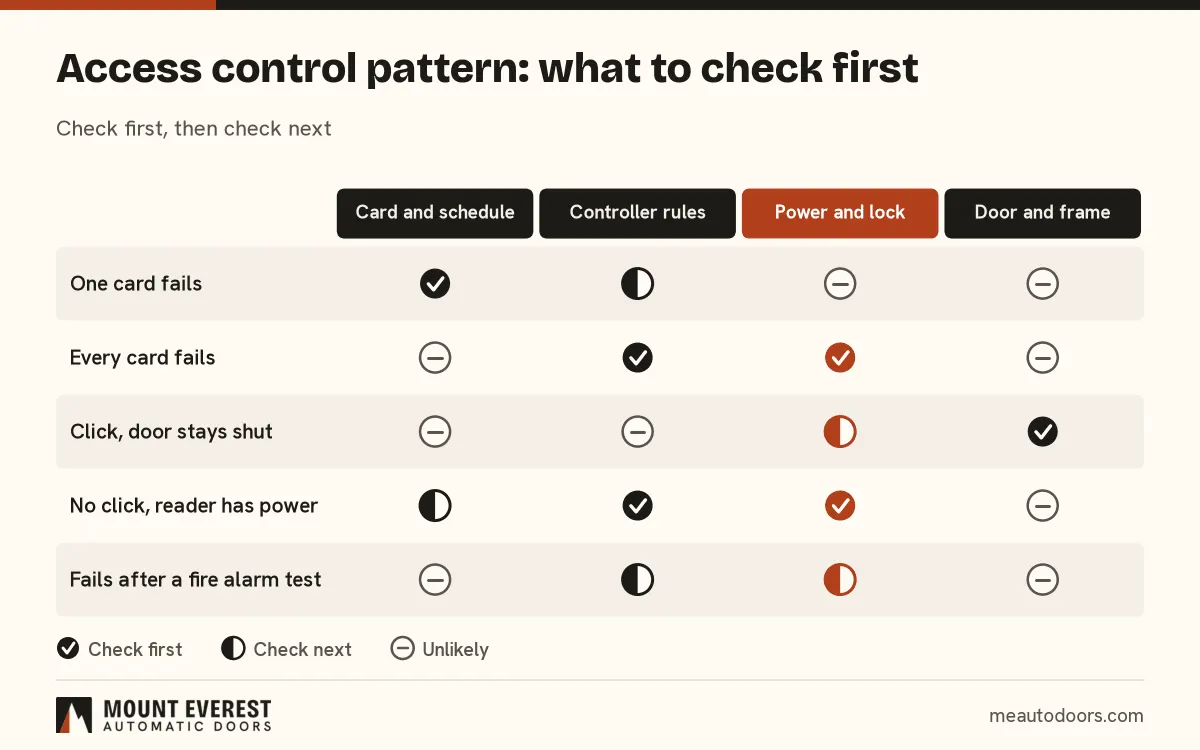
- No click at the lock points to the controller, relay or wiring. A click with a shut door points to the lock or the door.
- One card failing is an enrolment or schedule problem. Every card failing is a controller, power or relay problem.
- Do not bypass a lock on a fire exit. Fire alarm release logic is part of the system.
- Send a photo of the reader, the controller and the lock to speed up the visit.
Why does the reader beep but the door stay locked?
Because the door has a chain of parts, and the beep comes from the first link. The reader reads the credential and sends it to a controller. The controller decides, switches a relay, and the relay feeds a lock. The lock then has to move against a door that is sometimes under pressure. Any link after the reader can fail while the beep still sounds.
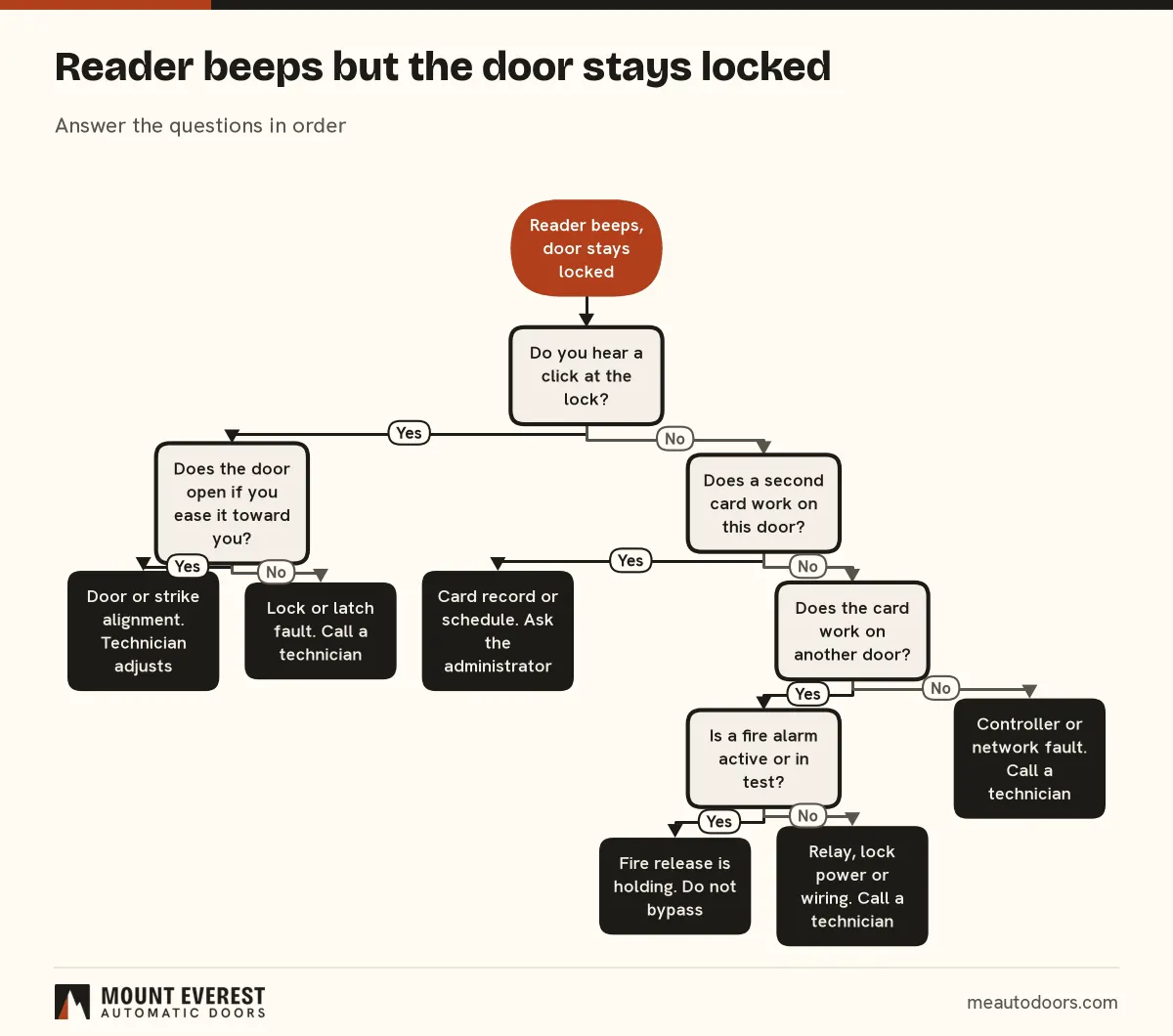
In Business Bay offices, Sheikh Zayed Road towers and Dubai Internet City campuses we meet the same few faults. Offices change tenants, fit out, move staff between floors, and a card that worked last month may no longer be enrolled for that door. This page gives a tree for the first checks, a table of what each pattern means, and a list of what to send us.
What does the symptom tell you?
Match what you see and hear to the first row of the table. The pattern narrows the cause before anyone opens a panel.
Symptom, likely cause, what to do
| What you notice | Likely cause | What to do |
|---|---|---|
| Beep, no click at the lock, one card | Card not enrolled for this door, expired, or outside its time schedule | Ask the system administrator to check the card record and schedule |
| Beep, no click, every card | Controller offline, relay or output wiring, or a rule such as a door held in lockdown | Technician checks the controller status and the relay output |
| Beep and a click, door stays shut | Lock moved but the door is binding on the strike, or the door has dropped | Ease the door pressure while the card is read, then call a technician |
| Beep, lock is silent, reader and keypad have power | Lock power supply off, low or tripped | Technician tests supply voltage and the lock coil or strike |
| Works from inside the exit button, not from the card | Reader side or controller input fault, while the lock itself is fine | Technician checks the reader cable and the controller input |
| Everything fails after a fire alarm test | Fire release state still active | Reset through the fire panel owner. Do not bypass |
Is it the card, the controller or the lock?
Run three quick tests. They take a few minutes and need no tools.
- Listen at the lock. Hold the card to the reader and put your ear near the strike or the magnet. An electric strike clicks. A magnetic lock gives a soft clack as the magnet lets go. Silence means the lock did not get its command or its power.
- Try a second card. A card that a colleague uses on the same door tells you whether the fault follows the card or the door.
- Try a second door. If the card works on another door, the card is fine. If every card fails on every door at once, look at the controller or the network.
Our shorter notes on card readers that stop working cover the reader-side faults. The question here is the door that will not release after a valid read, and the FAQ on a ZKTeco unit that grants access on screen while the door stays locked describes the same pattern for one brand.
Why does the lock click but the door will not open?
An electric strike releases the latch. If the door is pushed against the frame, the latch can bind on the strike and will not move, even though the strike has released. In towers with strong air pressure, such as an entrance lobby with a high air handling load, a door can pull toward the frame and bind. Doors also sag over time. A door that has dropped a few millimetres can land on the strike edge.
Try this: ask a colleague to ease the door gently toward you while someone reads the card. If it opens, the issue is door alignment or strike position, and the controller is fine. Adjusting hinges or the strike plate is a technician job on fire-rated doors, because the door and the frame are part of a tested set.
What about fire alarms and emergency release?
Access control in a building is not allowed to trap people. Most systems release locks on a fire alarm input, either a dry contact from the fire panel or a break glass unit at the door. When that input is active, the reader may still beep, but the door state is governed by the fire release logic, not by the card.
That means two things. First, never wedge a fire exit open, bridge a lock or remove a break glass cover to get through a stuck door. Second, if the door is locked when it should be released, or open when it should be locked, that is a safety defect and not a nuisance. Read our guide on access control and fire alarm integration and our FAQ on how a fire alarm affects electric locks. Confirm what your building requires with the building management or the Civil Defence consultant. We do not decide that for you.
Which brands and parts are involved?
The reader, controller and lock are often three brands in one door. In Dubai offices we meet ZKTeco readers and controllers on many doors, and Suprema terminals where biometrics are used. Our access control systems page lists what we install, and our access control repair in Dubai page shows the service area. For a new door, see RFID card access control installation in Dubai.
The door hardware matters as much as the electronics. A pedestrian lane with a turnstile gate or swing gate barrier has its own release logic, and an automatic sliding glass door at a lobby has a second lock circuit again. Name the door type when you contact us.
What should you send us?
Two photos and a few lines of text let a technician arrive with the likely part.
What to send us
- A photo of the reader and the door it controls, taken from the side where the card is read.
- A photo of the lock or strike on the door edge, and the door closed.
- The controller, panel or terminal label if you can see it, and the system brand.
- What you hear: a click, a soft clack or nothing, and which cards fail.
- The building or area: Business Bay, Sheikh Zayed Road, Internet City or another community.
- Whether the door is a fire exit or on a fire alarm release.
How does a visit with Mount Everest work?
Mount Everest Automatic Doors is an installer and service company. We do not make the readers, controllers or locks we fit. Our base is in Al Quoz, Dubai. A technician visits, listens to the symptom, tests the card chain from reader to lock, and checks the supply and the door condition. We explain the fault and give a written quote for any part before we replace it.
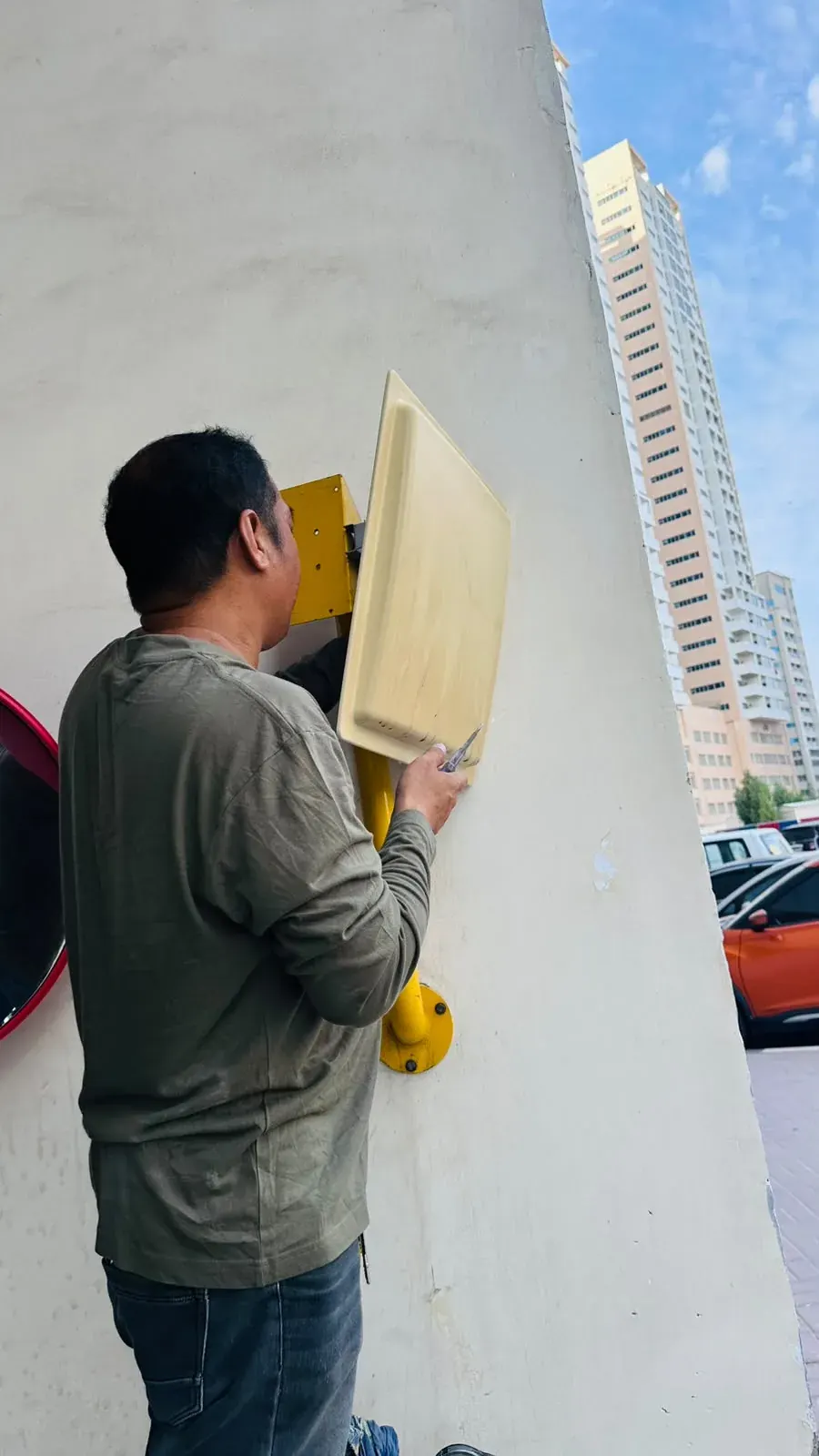
See a recent job: the access control reader replacement in Ajman. The record describes a reader on a yellow bracket at a pillar, wired back to a controller, with the old settings checked so existing users are not locked out. The same care applies to any reader we replace in Dubai.
Frequently asked questions
Why does the reader beep for some people but not others?
A beep for one person and silence for another usually means the credentials differ. One card may be enrolled and the other not, or one may be outside its time schedule or valid dates. Ask your administrator to check the record for the failing card on that door. If every card fails, the controller or the lock is the likelier cause.
Can I reset the reader to fix a locked door?
A reset rarely helps, and it can erase settings that took time to enter. The reader is only the front end. Power-cycling the controller can clear a software fault, but only after the administrator has saved the configuration. Do not factory-reset any unit without a technician, because card records and door rules may be lost.
Is a magnetic lock different from an electric strike?
Yes. A magnetic lock holds the door shut by magnetism and lets go when power is cut. An electric strike releases a mechanical latch when power is applied. The two fail in different ways. A magnet can hold if power stays on or if the door plate is misaligned, while a strike can bind under pressure. Name your lock type when you contact us.
Does a power cut lock people out?
It depends on the lock type and the battery backup. Many fire exit doors are set to release on power loss. Others stay locked and rely on a battery. Check what your doors are set to before a planned shutdown, and ask the building management whether any door needs a manual override. We can tell you how a door is wired after a visit.
How do I know if the fire alarm is holding the door?
If the alarm panel shows an active alarm or a test in progress, the doors on release may be released or the reader may be disabled. After a test, doors normally return to normal. If the building is clear and the panel is normal but the door stays locked, report it. Do not bridge any lock yourself.
What does a typical reader or controller repair involve?
The technician checks the supply, tests the relay and the lock, inspects wiring and connectors, and checks the reader. Weather, dust and impact are the usual wear on outdoor readers. Where a part is replaced, the old settings are checked so users are not locked out. We confirm the door lock and release behaviour before leaving.
Ready to get the door working?
Call +971 50 494 8667 or use the quote form. Send photos of the reader, the lock and the controller label through send a photo, or book a site visit. We work in Dubai first and book jobs in other emirates by appointment. We give a written quote after seeing the job, and we do not guess prices.
Want this done properly?
Send a photo of your door or gate and we will tell you what we see.