
Short answer: A slow automatic glass door usually has a dirty or worn track, rollers or belt. A door that hesitates is often seeing something it should ignore, such as a sign or air movement. A door that reverses is usually detecting an obstruction in the path or binding on its guide. Clear and clean first, then call a technician if it repeats.
In short
- Slow, hesitating and reversing are three different faults with three different usual causes.
- Most reversing faults come from something in the path or on a sensor, not from the motor.
- Ghost opening and hesitation are often caused by what the sensor can see.
- Never force a door panel or reach into the header while the power is on.
- Keep a log: day, time, how often and what was happening. A technician finds the cause faster.
How does an automatic sliding glass door work?
An operator in the header drives the door panels along a track, usually through a belt, and sensors tell the controller when to open and when to stop. Knowing the parts helps you describe the fault.
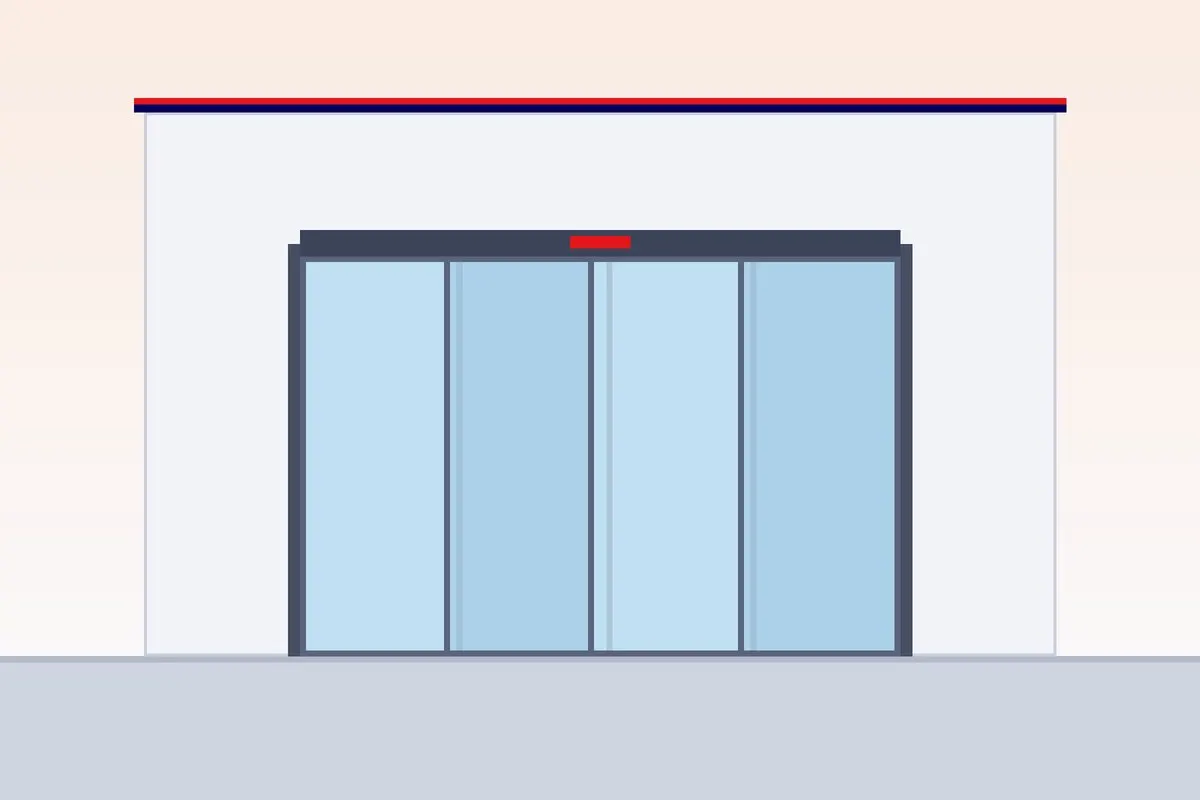
- Operator and controller: the motor and the board that decides speed, hold open time and force.
- Belt and carriages: the belt pulls the panels, and carriages with rollers hang the panels on the track.
- Floor guide: a small guide at the bottom keeps the panels in line.
- Activation sensor: sees a person approaching and tells the door to open.
- Safety sensors: watch the door path so the panels do not close on a person or a trolley.
- Mode switch: sets automatic, one way, locked or held open.
Our page on automatic sliding glass doors shows the range. The service page for revolving and sliding glass doors covers repair and care.
Why does my automatic glass door open slowly?
A slow door means something is resisting the panels or the operator is asked to move them more gently. Dirt in the track, worn rollers, a slipping belt or a sagging panel are the usual physical causes.
Dubai conditions make this common. Sand and fine dust get onto the track from shop entrances, and dust blows in whenever the door opens. It builds up in the floor guide and the track groove, and the rollers run rough. Wheels wear out in time, as our FAQ on why the wheels on an automatic sliding glass door wear out explains. A stretched or glazed belt gives the same symptom, so read the FAQ on how to tell if a belt needs replacing.
Other causes are more settled. Someone may have changed the speed setting, or the controller may be in a reduced mode that is meant to save energy or limit the opening width. Do not change settings unless the manual says how, and note the current ones first.
Why does it hesitate or open for no reason?
Hesitation and ghost opening usually mean the sensor sees something moving, or the signal is dropping out for a moment. Look at what is in front of the sensor, not at the door.
- A hanging sign, a banner, a plant or a curtain that moves in the air flow.
- An air conditioning vent blowing across the sensor field.
- Strong reflections or glare from a polished floor or a bright window.
- A sticker, tape or dirt on the lens that changes how the sensor sees.
- A loose connector or a worn cable between the sensor and the controller.
A sensor that stops detecting people is a separate fault. See our FAQ on why the sensor on an automatic glass door stops detecting people, and the practical checks in what to check when an automatic door does not detect people.
Why does it reverse when closing?
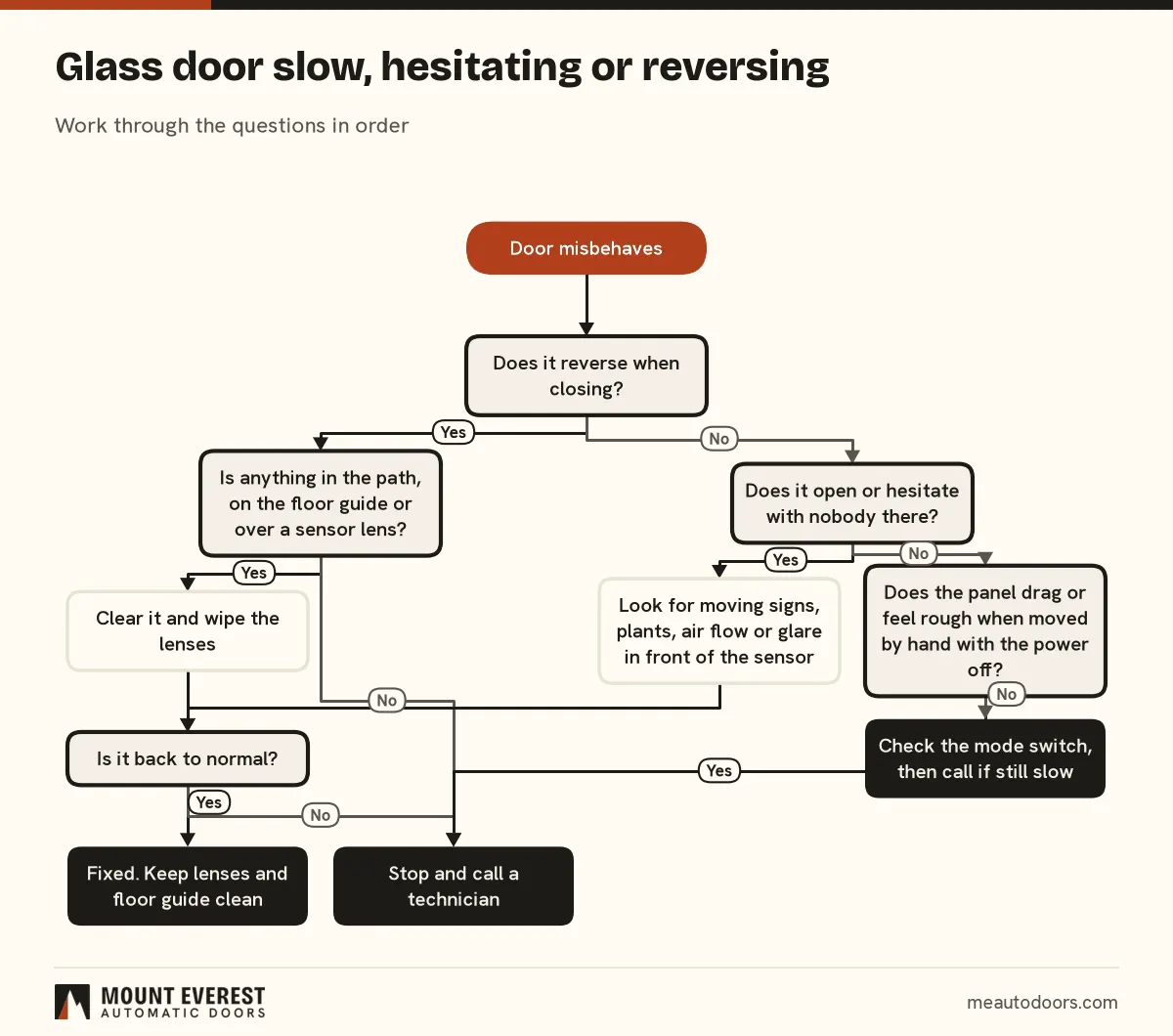
A reversing door thinks something is in the way, or the panel is binding. This is a safety behaviour, so do not try to switch it off. The cause is either an object in the path or friction at the track or the floor guide.
Check, in this order:
- Is there anything on the floor guide, a mat that has curled or a pebble in the groove?
- Is something stuck on a safety sensor lens, or is the sensor dirty?
- Has a trolley, a bin or a display moved into the door path?
- Does the panel feel rough or tight when moved by hand with the power off, as the manual allows?
If you find and clear the cause, test the door a few times. If it still reverses, stop and call a technician. A door that does not reverse when it should is a safety issue, so never bypass a sensor.
Which symptom points to which cause?
| Symptom | Common cause | First action |
|---|---|---|
| Slow opening or closing | Dirty track, worn rollers, slipping belt, changed speed setting | Clean the track and floor guide, then book a visit |
| Grinding or rumbling noise | Worn rollers or debris in the track | Stop using the door in auto mode and book a visit |
| Hesitates mid travel | Sensor signal dropping, loose wiring, sticky track | Note when it happens and book a visit |
| Opens with nobody there | Moving sign, air flow, glare, dirty lens | Remove the trigger and wipe the lens |
| Reverses when closing | Object in path, binding panel, dirty safety sensor | Clear the path, wipe lenses, then call if it repeats |
| Panel leans or drags | Worn rollers or loose hangers | Stop, keep people clear and call a technician |
What can staff safely do, and what must wait for a technician?
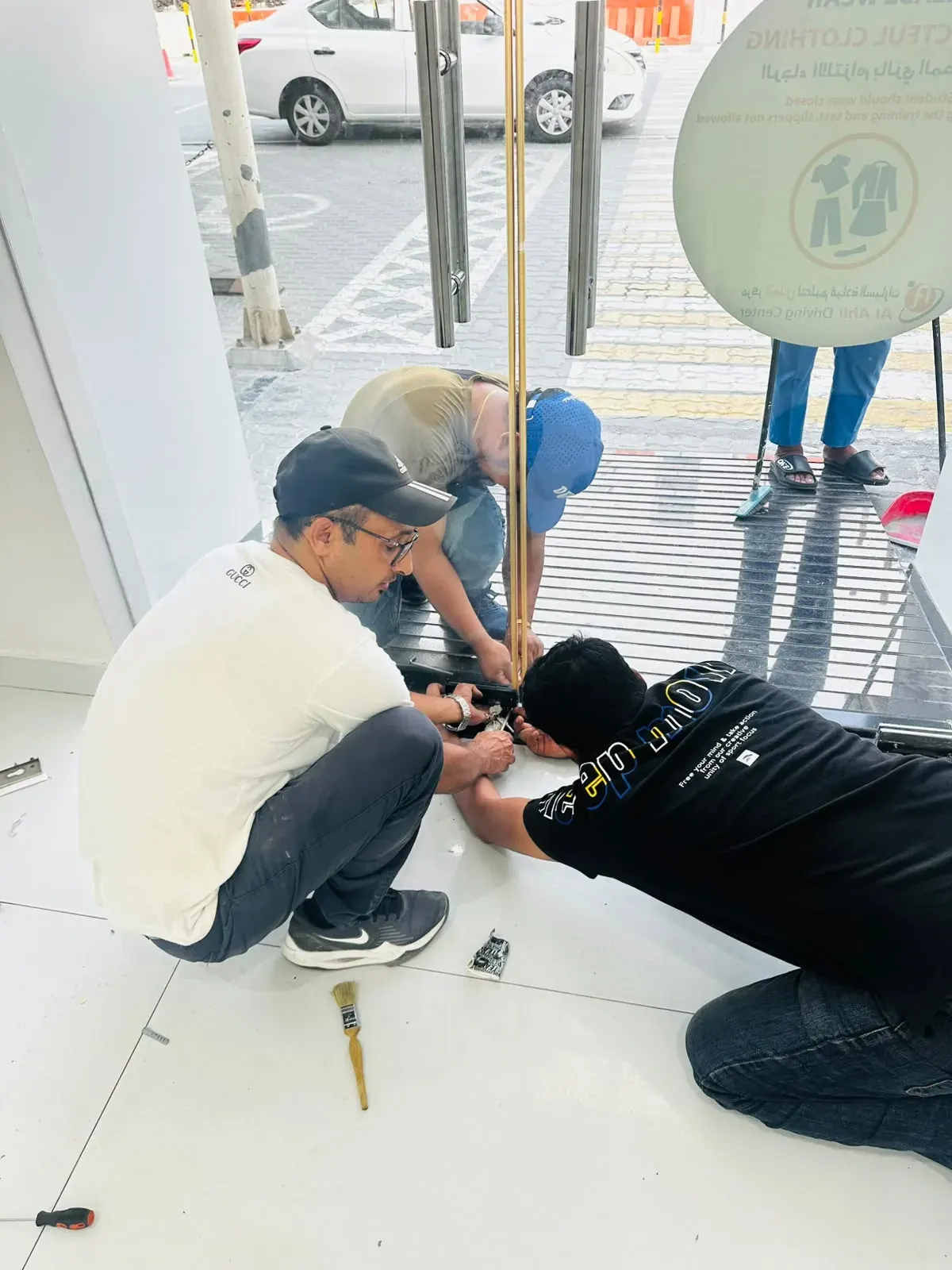
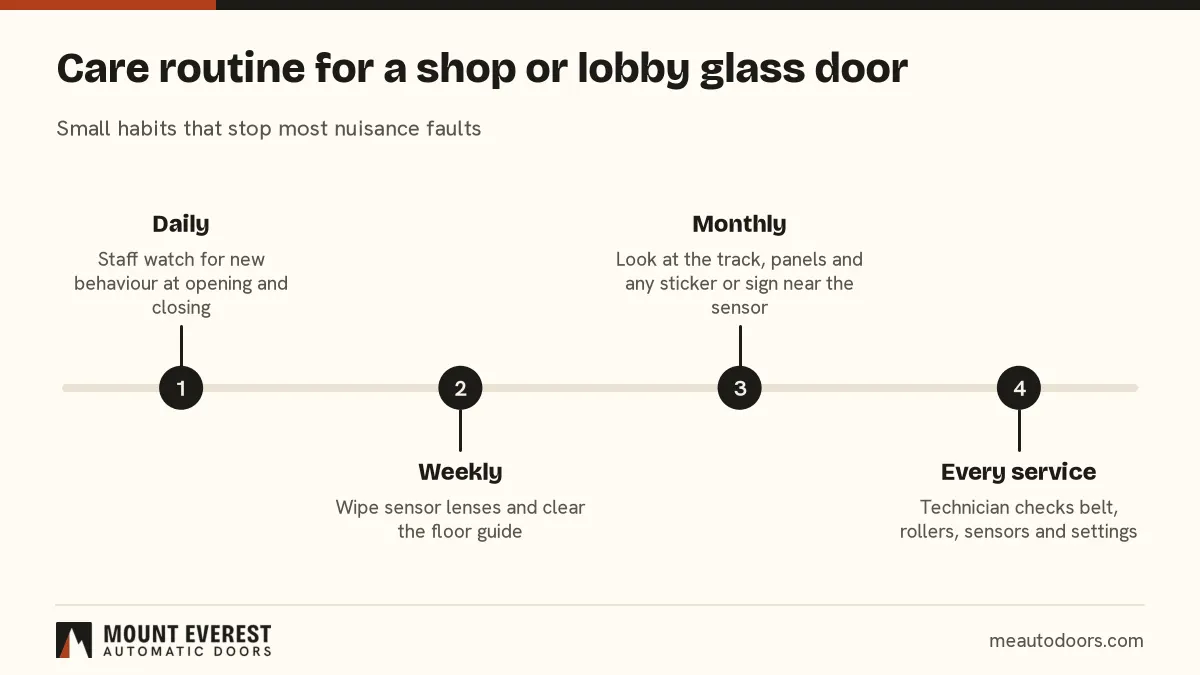
Staff can wipe, clear and watch. Technicians open the header.
- Staff can: wipe sensor lenses with a soft cloth, clear the floor guide, move signs and plants away from the sensor, and keep a log.
- Staff should not: open the header cover, adjust the belt, change controller settings or bypass a sensor.
- Technician only: belt, rollers, carriages, controller, sensor alignment, wiring and glass handling.
Heavy glass panels are dangerous to move. Never lift, re-hang or force a panel yourself.
What does a service visit cover?
A service checks the parts that cause the faults above, then tests the safety behaviour. The details are written into the quote, so you know what you are paying for.
- Track, rollers, carriages and floor guide: cleaned, checked for wear and tested for smooth travel.
- Belt: checked for tension, wear and glazing.
- Sensors: lenses cleaned, field and aim checked, and a test that the door stops and reverses on an obstruction.
- Controller: settings noted, speed and hold open time checked against the manual.
- Glass and hangers: panels checked for looseness, chips and alignment.
Project
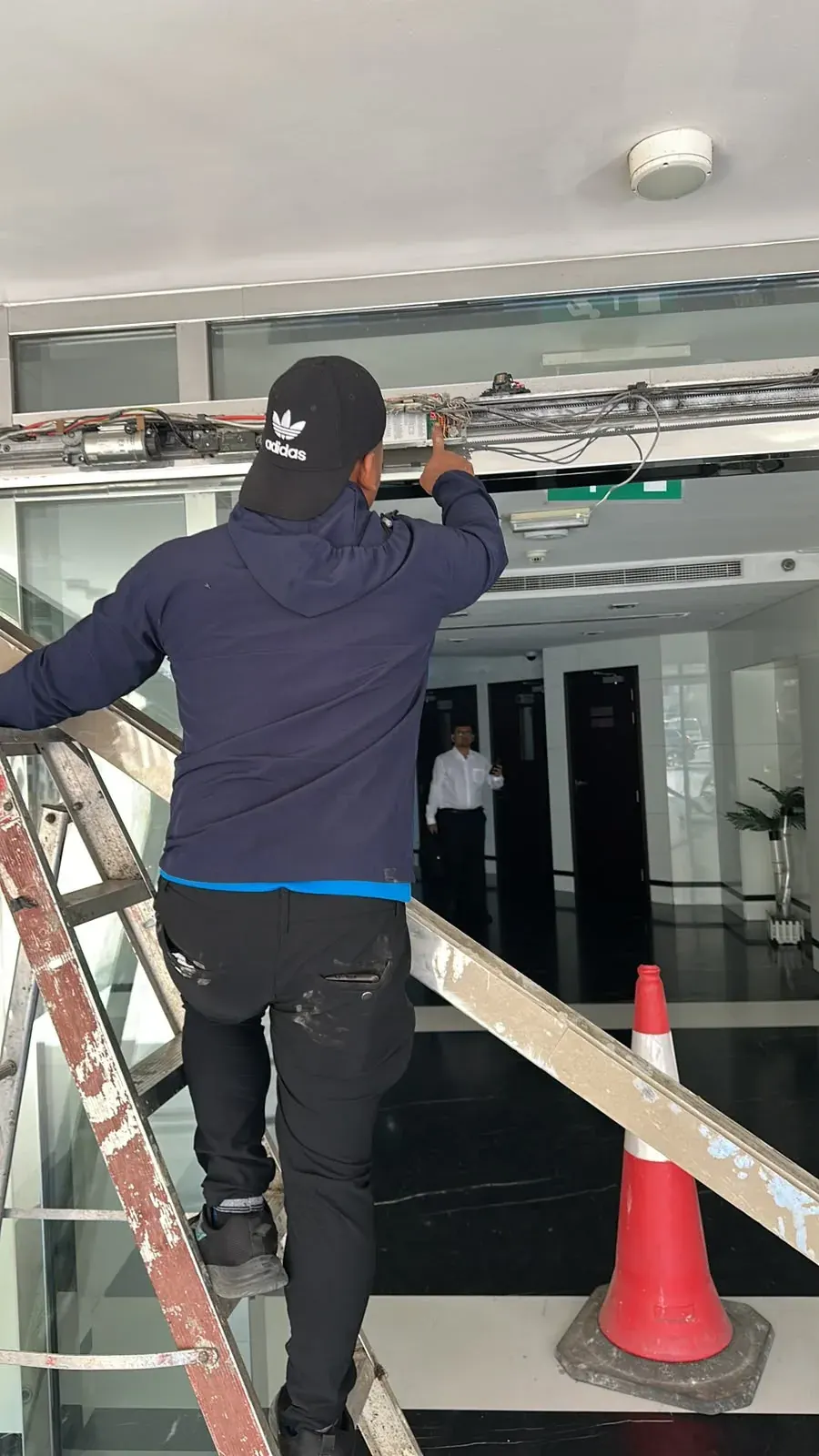
Automatic glass door maintenance in Deira, Dubai
The photo shows the header open on a lobby door in Deira. See the full project record. For shops in Deira, Al Quoz and Dubai Silicon Oasis, the same visit applies.
For lobbies with heavy traffic, automatic revolving doors are another entrance type, and if the lobby also needs to control who comes in, see turnstile gates. We also look at older brands. The brands page for GEZE, dormakaba and Tormax lists the operators we can service, and for new openings, see installing glass doors in Dubai. For a deeper read on faults, see our guide to a sliding door sensor that is not working.
Frequently asked questions
Why does my door open slowly only in the afternoon?
Heat can change how a sensor behaves and how a belt grips, and afternoon traffic brings more dust and more door cycles. It can also be a loose connection that moves as metal warms. Note the time, send a short video and a photo of the header, and we will say what to check.
Is a door that reverses by itself dangerous?
The reversing is the safe behaviour, since it protects people from being hit. The danger is in a door that does not reverse. If your door reverses without anything in the path, treat that as a fault and call a technician. Do not switch the sensor off.
Can I adjust the speed myself?
Not unless the manual for your operator shows how and you can note and restore the settings. Speed and closing force are safety related. We suggest leaving settings to a technician and writing down what the controller shows if you see a fault light.
Why does the door open when someone walks past outside?
The sensor field may be too wide or aimed too far out, or the sensor sees through the glass at passing traffic. A technician can narrow the field. Until then, a simple option is the one way or reduced mode if your door has it, as the manual allows.
How long can I run a door that is making noise?
Not for long. A rough roller or a dragging panel wears the track and the belt faster, and a repair that starts small can become a larger job. Switch to manual or one way mode if you can, and book a visit.
What should I film for the technician?
A short clip of the fault, a photo of the sensor and its label, a photo of the open header only if it is safe, and the door brand if you can see it. Also tell us how often the fault happens and what changed before it started, such as a new sign or a cleaning visit.
Send us the details and we will advise
What to send us
- A short video of the fault and a photo of the whole door from the front
- A photo of the sensor above the door and any label on it
- The operator brand, such as GEZE, dormakaba or Tormax, if you can see it
- When it happens, how often, and anything that changed recently
- Your shop or building location, for example Deira, Al Quoz or Dubai Silicon Oasis
Call or WhatsApp +971 50 494 8667, ask for a written offer on the quote form, send photos through the photo page, or book a visit on the site visit page. Mount Everest Automatic Doors covers Dubai first and books jobs in the other emirates by appointment.
Want this done properly?
Send a photo of your door or gate and we will tell you what we see.