
Short answer: A vendor prequalification questionnaire for doors and barriers should cover company status, scope and brands, technical capability, safety, service and spare parts, references and site rules. Split the questions into pass or fail gates and scored items, ask for evidence with every answer, and confirm the answers with a reference call and a short site visit before you shortlist anyone.
In short
- Make licence, insurance and safety method pass or fail gates. Score the rest.
- Ask for evidence: a document, a named reference or a visit.
- Test service capability: who attends, what is stocked, how a call escalates.
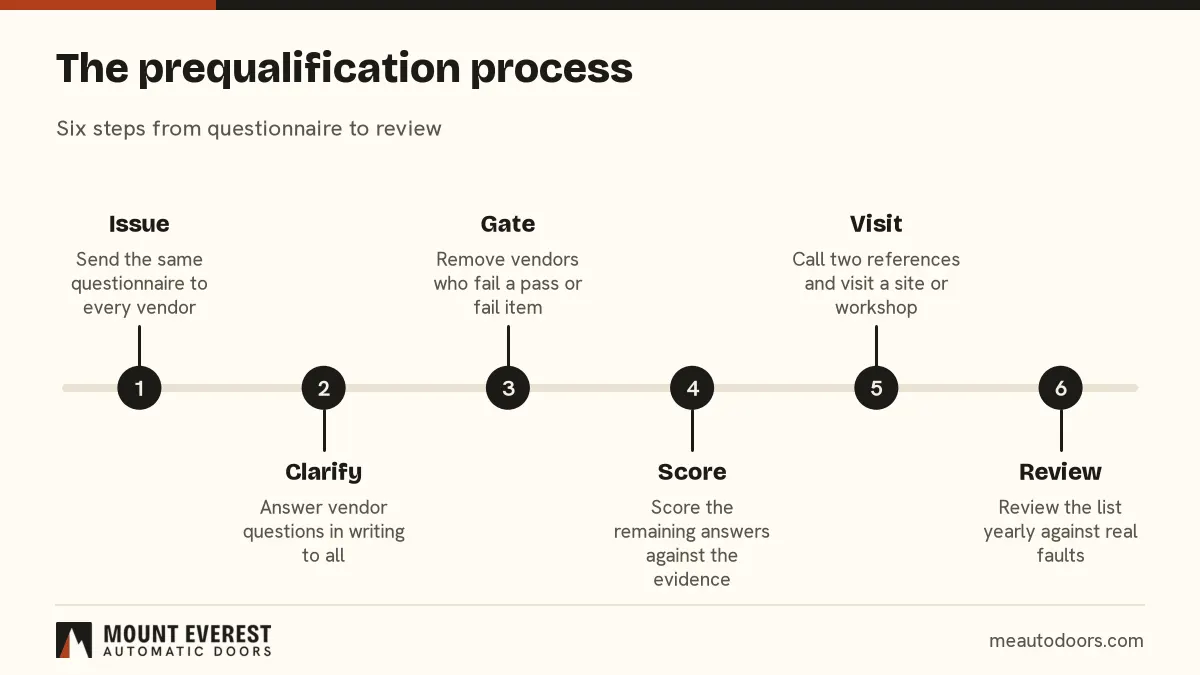
- Send the same questionnaire to every vendor so scores compare.
- Update the list each year using the faults you really had.
What is a vendor prequalification questionnaire for door and barrier suppliers?
It is a standard set of questions a facility manager sends to every supplier before they can quote or sign a service contract. It answers one question: is this vendor able to do the work safely, keep our equipment running and tell us honestly when something is wrong? A door or barrier is a safety critical moving machine at a building entrance, so the questions go further than for stationery or cleaning.
In warehouse and industrial zones the stakes are practical. A rolling shutter that will not close leaves a unit open overnight. A dock leveler that sticks stops loading. A barrier that fails in the morning rush makes a queue. Facility managers in Al Quoz, Jebel Ali, Dubai Investments Park and Dubai Industrial City deal with these faults often. Our symptom guide to industrial door and gate breakdowns shows which ones repeat, and those are the faults your questionnaire should test for.
Which sections should the questionnaire have?
Seven sections cover the ground. Keep each one short and ask for a document or a name behind every claim.
Questionnaire sections, what to ask and what to request
| Section | What to ask | Evidence to request |
|---|---|---|
| Company status | Trade licence activity, the emirate it covers, insurance in force | Licence copy, insurance certificate |
| Safety | Method for work at height, electrical isolation, permits, site induction | Sample method statement and risk assessment |
| Scope and brands | Which equipment and brands they install and service | Brand list, sample datasheets |
| Technical capability | Survey process, drawings, who commissions and tests | Sample survey report and test record |
| Service and spares | Who attends, which hours, what is stocked, how a call escalates | Service procedure, spares list |
| References | Similar sites in Dubai with a contact you may call | Two named references |
| Reporting | What you receive after a visit and how faults are tracked | Sample service report |
Which questions should be pass or fail gates?
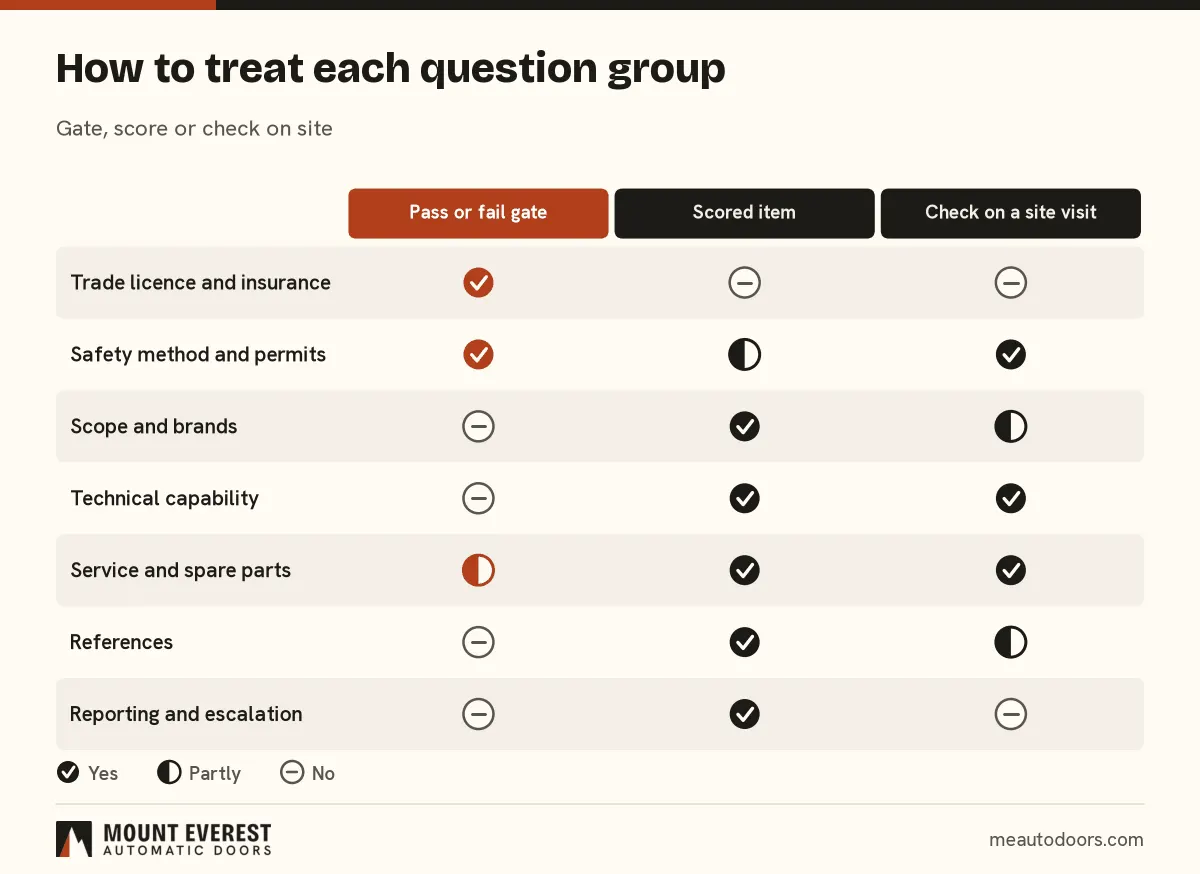
Make the gates the items where a wrong answer creates legal or safety exposure for you. If a vendor fails one, stop reading their answers.
- Does the vendor hold a valid trade licence for door, gate or automation work, and for the emirate where the work happens? Check the licence copy yourself, and ask what the licensed activity says.
- Is insurance in force that covers work at your building? Ask for the certificate, and confirm with your own policy and the building management what they require.
- Does the vendor provide a method statement and risk assessment for work at height and electrical work?
- Can the vendor comply with your site access, permit and working hour rules?
Everything else, from brands to reporting, is better scored than gated. A vendor with fewer brands may still be the right choice for a site that has one.
What should you ask about technical capability?
Ask how the vendor surveys, draws and commissions, and what a job looks like when it goes right. Vague answers like "we do it all" tell you little. A specific answer names the steps.
- What do you measure and photograph on a survey, and what do I receive afterwards?
- Do you work from drawings, and who approves them?
- Who tests the safety devices, and is the test recorded?
- How do you handle equipment from a brand you do not normally stock?
- For automatic gates and barriers, how do you check the safety stop and reverse?
For standards, ask what the vendor refers to when it checks safety, for example the general standards for power operated doors, and ask how the vendor confirms the match with your consultant's requirements. A reliable vendor explains in plain words and says when something is outside its scope. A vendor that claims a certification should show the document.
How do you test service capability?
Service capability is the most common gap, so test it directly. Ask for the process, not a promise.
Service questions and what a useful answer includes
| Question | A useful answer | Weak answer |
|---|---|---|
| Who attends a call? | Named role and how they are assigned | "Our team will come" |
| What are the service hours and how are out of hours calls handled? | Stated hours and a defined out of hours route | "Any time" |
| What spare parts do you hold? | A list by brand and part type | "We can get anything" |
| How does a fault escalate? | Named steps and contacts | "Call the office" |
| What do I receive after a visit? | A written report listing checks and findings | A verbal summary |
If you plan a service contract, ask the vendor to explain how it would define response and restoration, and compare that with our guide to how to choose a door maintenance plan in Dubai and our short answer on what a maintenance contract for doors and gates should cover.
How do you score the answers fairly?
Use the same scale for each vendor and score only what has evidence. A simple three level scale is enough: no evidence, partial evidence, full evidence. Agree the weights before the answers arrive, so no one can tune them to favour a vendor.
- List the scored questions and give each a weight that reflects its risk to your site.
- Score each answer on the three level scale and record the evidence reference.
- Add notes where you want to ask a follow up question.
- Compare totals, but read the notes. A vendor with a high score and one weak safety answer needs a conversation.
What are the red flags in vendor answers?
Red flags are answers that cannot be checked or avoid the question. One alone is not a reason to reject, but several together are.
- Claims with no document, no name or no site to see.
- A different answer on the phone and in writing.
- No written method for work at height or electrical isolation.
- Spare parts promised for every brand, with no list.
- A reluctance to let you call a reference or visit a site.
- A quote that skips the survey.
What should you check on a site visit or reference call?
Visit one site where the vendor has worked, or the workshop, and speak to a reference. Ask whether the vendor arrived when they said, whether the work matched the quote and whether the report was clear. Look at the finished work: neat cable routing, labelled controls, clean mounting, and the safety devices present and working. For heavy equipment such as a dock leveler, ask to see the pit and the controls after service, and read our short answer on how to pick the correct dock leveler for a loading bay.
Pay attention to how the vendor talks about the equipment already on your site, whether automatic rolling shutters, double skin insulated shutters, high speed doors or sliding barriers. A good vendor asks about the model and the age before talking about price.
What to send us
- An equipment list: door, shutter, dock leveler or barrier, location and quantity.
- Brand and model for each, from the label or a photo of the control box.
- Your questionnaire and the scoring sheet, if you have one.
- Your site rules: working hours, permits, induction and access passes.
- The faults you have had in the past year and how long each took to fix.
How does a visit with Mount Everest work?
Mount Everest Automatic Doors is an installer and service company. We do not manufacture the equipment we fit or service. Our base is in Al Quoz, Dubai. We answer prequalification questions in writing, say plainly where something is outside our scope, and walk the equipment with you before we quote. After the visit you receive a written report of what was checked and found.
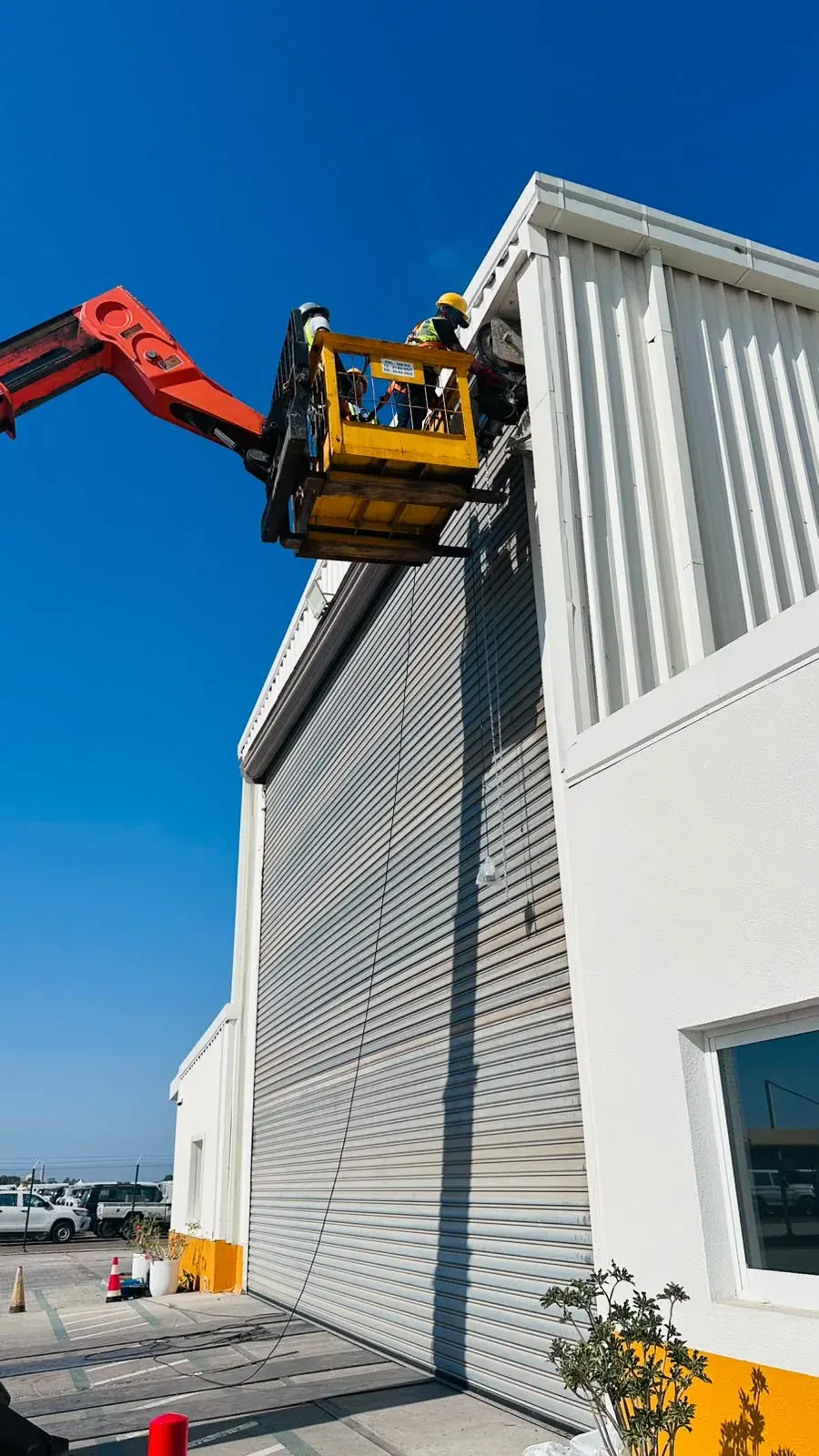
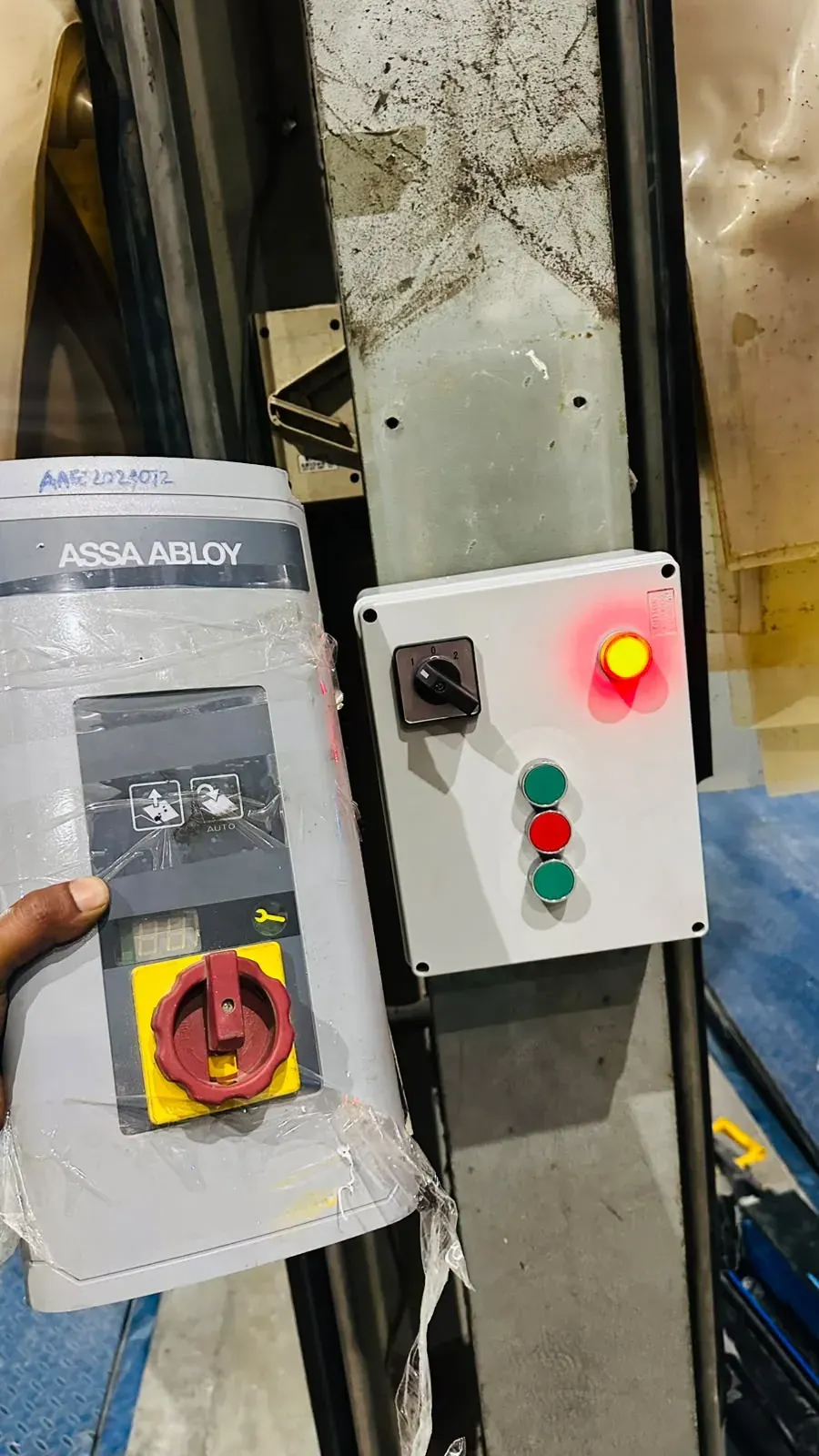
See a recent job: the rolling shutter maintenance in Jebel Ali Free Zone, where the record describes technicians in a lifting basket servicing the top of a tall shutter. Also see the dock leveler controller replacement in Al Quoz. Our high speed doors and dock levelers pages list the equipment, ASSA ABLOY is one of the brands we work with, and a maintenance contract sets out routine visits for sites with many doors. Our broader piece on automatic door maintenance and annual contracts shows how routine visits are usually structured.
Frequently asked questions
How long should a prequalification questionnaire be?
Keep it to one or two pages of questions that a vendor can answer in under an hour. Long questionnaires get copied answers. Put the gates first so you can stop early, and move detailed technical questions to the shortlist stage when only a few vendors remain.
Should small vendors be excluded?
No. Size is not capability. A small vendor with a good method, clear references and a spare parts list may serve a single building better than a large one. Use the same questions for all, and judge on evidence, insurance and the ability to attend when you call.
Do we need a separate questionnaire for barriers and gates?
Add a short section rather than a second document. For barriers and gates, ask how the vendor tests the loop, the safety beam and the stop and reverse, and how it keeps the lane safe while it works. The rest of the questionnaire applies as written.
Can a vendor give a reference at a site that is still under contract?
Yes, if the client agrees. Ask for contacts the vendor has permission to share, and speak to them yourself. A vendor that cannot name a single site it has worked on in Dubai is a risk for a safety critical machine.
How often should the questionnaire be refreshed?
Once a year, and after any serious fault or incident. Add questions that would have caught the problem, and remove those that never help you decide. Keep the version number on the form so past answers stay comparable.
Can I ask the vendor for a price in the questionnaire?
Better not. Prequalification is about capability. Ask for pricing at the quote stage, after the survey, when each vendor has seen the same equipment. A price before a visit is a guess, and guessed prices make bids hard to compare.
Ready to compare vendors?
Call +971 50 494 8667 or use the quote form. Send photos of your doors, shutters or barriers through send a photo, or book a site visit so we can answer your questionnaire against the real equipment. We work in Dubai first and book jobs in other emirates by appointment. We give a written quote after seeing the job, and we do not guess prices.
Want this done properly?
Send a photo of your door or gate and we will tell you what we see.