
Short answer: In a door maintenance contract, acknowledgement, response, attendance, make safe and restoration are separate clocks. Define each one, say when it starts and stops, set priority classes by what a fault does to the building, name an escalation ladder, and list the exclusions. Without those definitions a service level promise cannot be measured or enforced.
In short
- Response, attendance and restoration are different clocks. Name each one.
- State how a call is logged and when each clock starts and stops.
- Set priority classes by the effect on the building, not by the equipment.
- Write an escalation ladder with named roles and contacts.
- List delays and exclusions openly: parts lead time, access, permits.
Why do service level words cause disputes?
Because one phrase hides several clocks. "We respond within the agreed time" can mean a phone call, a message, a technician on the road or a technician at the door. The client thinks it means the door is fixed. The vendor thinks it means someone replied. Both are reading the same sentence in good faith.
The fix is to turn each word into a defined event with a start and a stop. This guide gives plain meanings you can paste into a contract, and the questions to ask a vendor about each. It does not give response times, because those depend on the site, the equipment and the agreement, and any figure here would be invented. For the bigger picture of what a contract covers, see our short answer on what a maintenance contract for doors and gates should cover and our guide to choosing a door maintenance plan in Dubai.
What do the main service level words mean?
Use the table as a glossary. Each row names the term, gives a plain meaning, and shows the question that turns it into something you can check.
Glossary of service level terms
| Term | Plain meaning | Question to settle in the contract |
|---|---|---|
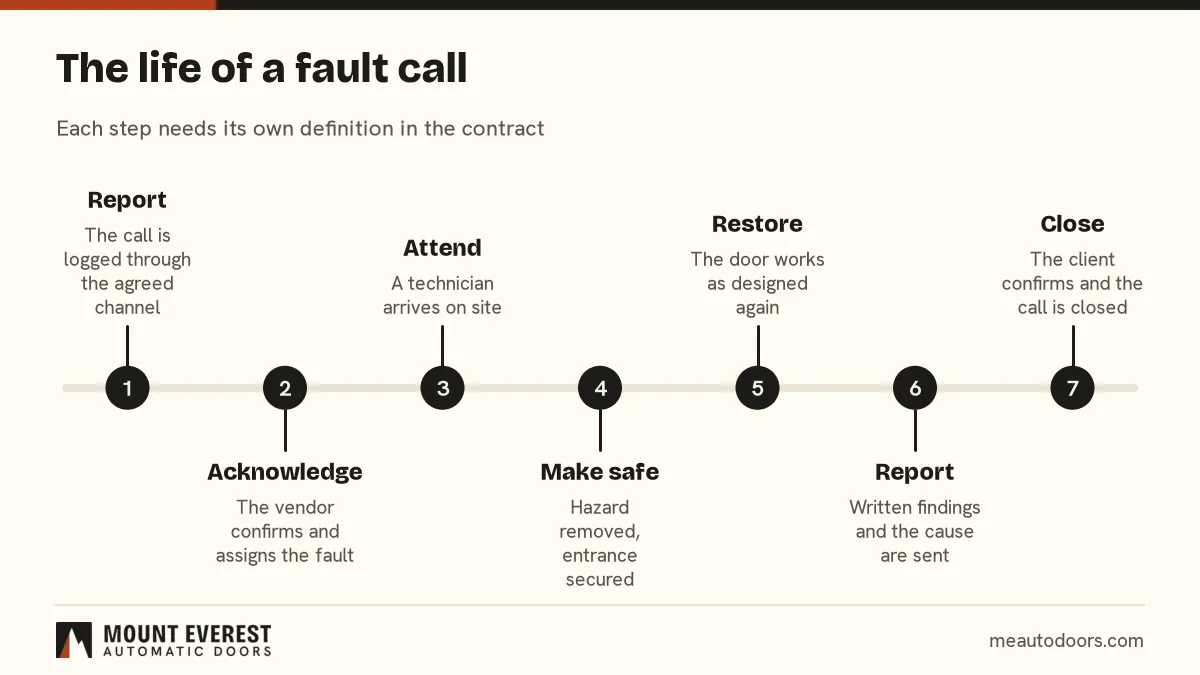
| Logging | The moment the call is recorded | Which channels count: phone, email, portal, message? |
| Acknowledgement | The vendor confirms the call and assigns it | How is it confirmed, and to whom? |
| Response | The first useful action on the fault, such as advice or dispatch | Is a phone call enough, or must someone be sent? |
| Attendance | A technician arrives at the door | Measured from logging or from acknowledgement? |
| Make safe | Hazard removed and the entrance secured, even if not fixed | Who decides it is safe, and is it recorded? |
| Restoration | The door works as designed again | Does a temporary fix count, or only a permanent one? |
| Escalation | The route a missed target takes upward | Which roles, in what order, with which contacts? |
| Working hours | The hours the clock runs at the normal level | What happens on weekends, holidays and at night? |
| Exclusions | Faults or causes the contract does not cover | Impact damage, misuse, parts lead time, missing access? |
How should response and restoration be written?
Write each as a clock with a start event, a stop event and a unit you can measure. The wording below is a template. Replace the brackets with what you and the vendor agree.
Clause template
The clock starts when the client logs a fault through [agreed channel], and the vendor records the time.
The vendor will acknowledge the call within [agreed time] and give the name of the technician assigned.
The vendor will attend the site within [agreed time] for Priority 1 faults, [agreed time] for Priority 2 faults and at the next planned visit for Priority 3 faults.
The vendor will make the entrance safe and secure on first attendance where possible, and will record what was done.
The vendor will restore the door to normal operation within [agreed time] of attendance, or will give a written reason and a revised date if a part or access is missing.
The clock pauses only for causes listed in the exclusions and recorded in writing.
The brackets are deliberate. We do not set the numbers for you because they depend on the building, the number of doors, the brand of equipment and the contract you choose. Ask each vendor to fill them in and to state which parts of the day they can meet. Compare the same priority class across vendors, not the headline figures.
How do you set priority classes?
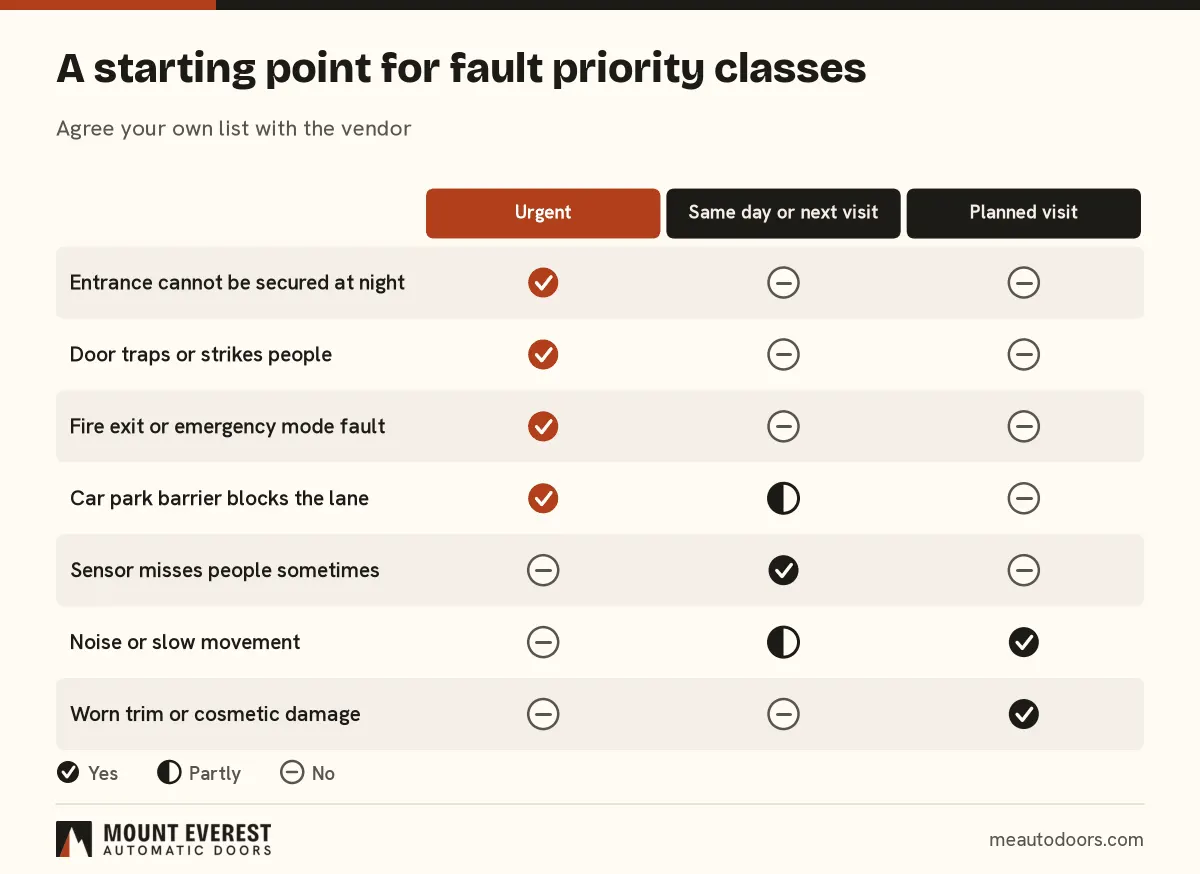
Set classes by what the fault does to the building, not by the type of equipment. A noisy sliding door in a lobby is not the same as a barrier that blocks a car park lane. Three classes are usually enough.
- Urgent. The entrance cannot be secured, the door traps or strikes people, an emergency or fire mode fails, or a car park lane is blocked.
- Same day or next visit. The door works but not reliably, for example a sensor that misses people sometimes.
- Planned visit. Noise, slow movement or cosmetic wear that does not affect safety or security.
A simple rule helps: if a person could be hurt or the building cannot be secured, the fault is urgent. Fire and emergency behaviour follow the building's fire strategy and the authority, so involve the consultant or building management when you assign those classes. Our short answer on what happens to an automatic door if the power goes off shows the kind of behaviour that belongs in the urgent list.
What should the escalation ladder say?
An escalation ladder says who gets the call when a target is missed. It has named roles, an order and a contact route for each step. A typical ladder has four rungs: the assigned technician, the service supervisor, the account or service manager, and a senior manager of the vendor. Each rung has a time or a trigger, such as "no attendance by the agreed time" or "fault not restored at the agreed time".
Write the ladder into the contract as a table with the role, the contact and the trigger. Ask the vendor to confirm in writing when a name changes. Put the client side on the table too, with the facilities manager and the person who can approve access, so delays at the client end are visible.
What delays and exclusions should be written down?
Write them openly, because they will happen. Fair exclusions protect the vendor from unreasonable claims and protect you from vague excuses. Four groups cover most cases.
- Access. The vendor could not enter the building or the plant room. Record who refused or delayed and when.
- Permits. A work permit was not issued. Towers in Downtown Dubai and Business Bay often need passes and fixed working hours, so the clock should reflect them.
- Parts. A part has to be ordered. The contract should say who approves the order and how the vendor reports the expected date. See also our note on service intervals for a sliding barrier on a busy entrance, because a regular visit catches worn parts before they fail.
- Causes outside the contract. Impact damage, misuse, water ingress or work by another contractor. Say how the vendor proves the cause, for example with photos in the report.
What should the reports and records show?
Ask for a record after every visit and a short monthly summary. The record should list the time logged, acknowledged, attended and restored, what was found, what was done, and what is still open. The summary should show the number of calls by priority class, repeat faults on the same door and whether planned visits happened. These are the numbers you use to judge the service, and they let you see patterns that one call does not.
For example, if the same sensor fails three times in a month, the report should say so and recommend a different fix. A report that only lists "attended and tested" hides the pattern. Repeat faults on busy entrances, such as the glass doors on a lobby in Al Quoz or Deira, are the clearest sign that the contract needs an adjustment.
What to send us
- A list of the doors, shutters, gates and barriers to cover, with location and brand if known.
- Photos of the control boxes or labels so we can identify models.
- Your current contract or the clause wording you want to compare, if you have one.
- Building rules: working hours, permits, access passes and who can approve entry.
- The faults you have had in the last year and how long each took to fix.
How does a visit with Mount Everest work?
Mount Everest Automatic Doors is an installer and service company. We do not manufacture the equipment we service. Our base is in Al Quoz, Dubai. We survey the equipment before we write a service plan, then set out in the agreement what each term means for your building, and give you a written quote. We do not publish response times here because they depend on the site, the equipment and the plan, and we put them in the agreement instead of the brochure.
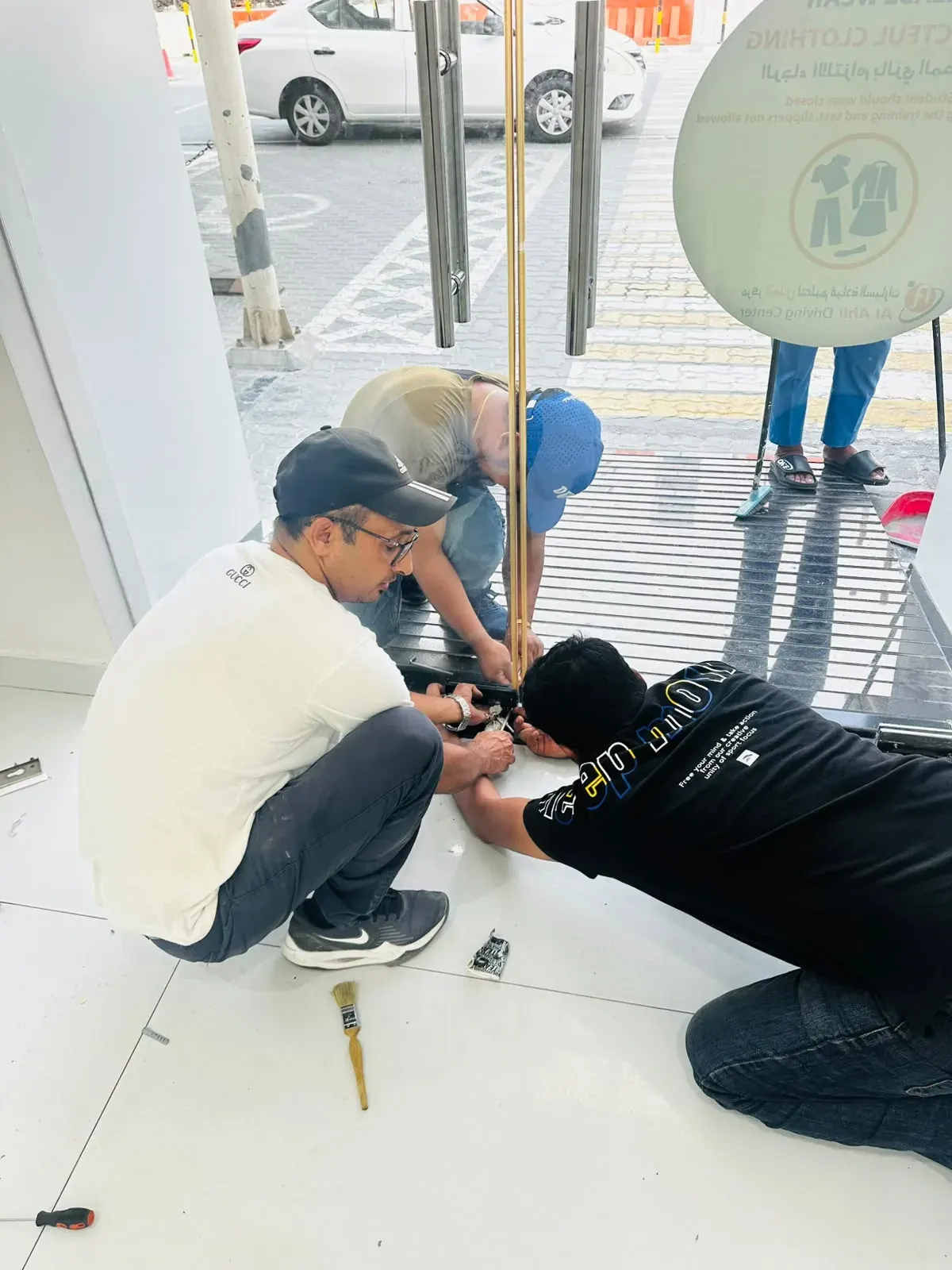
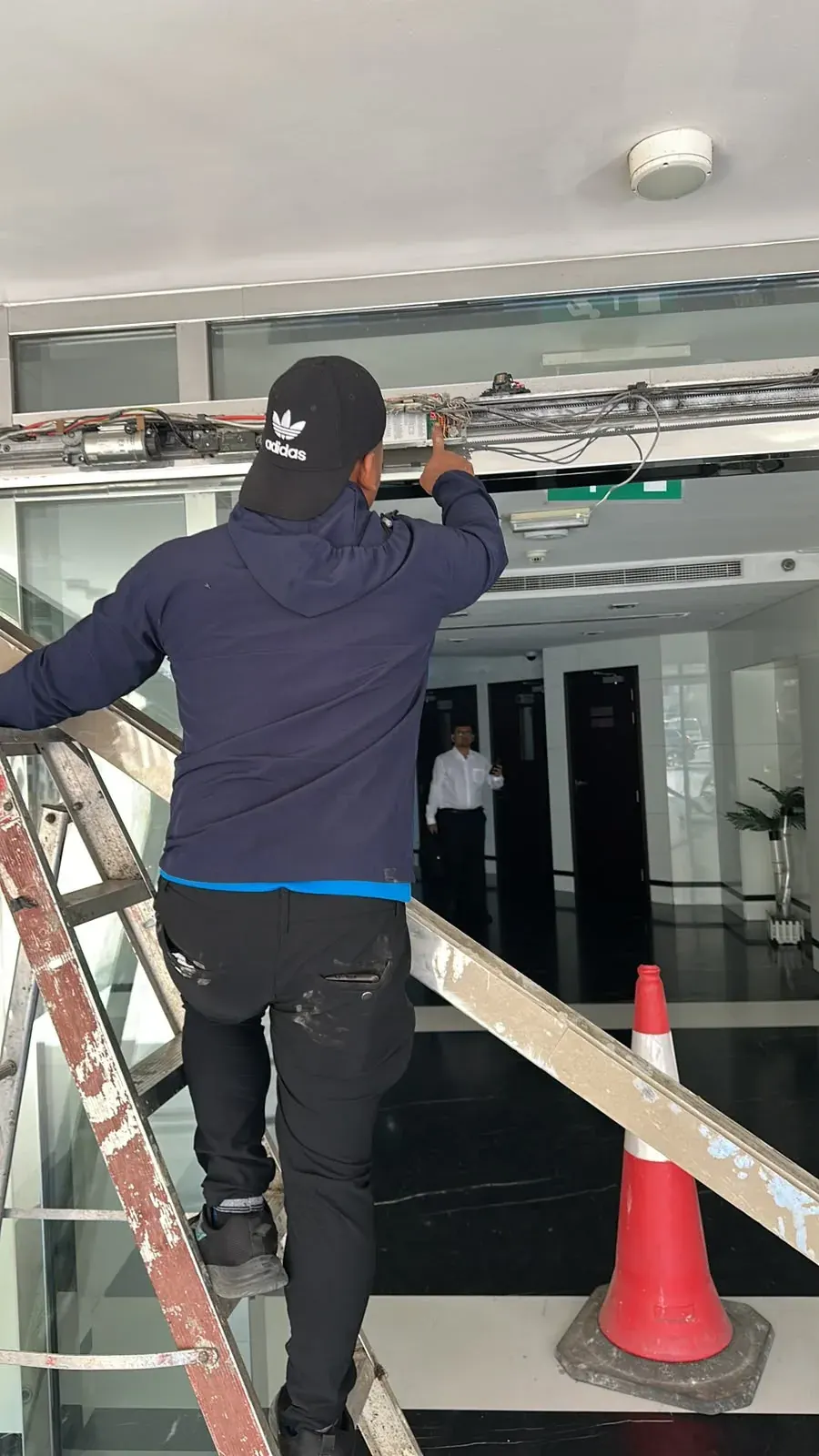
See a recent job: the glass door maintenance in Al Quoz. The record describes three technicians servicing the floor hardware of a glass entrance door. Also see the automatic glass door maintenance in Deira. For the equipment, see automatic sliding glass doors, automatic revolving doors, automatic rolling shutters and sliding barriers. Our revolving and sliding glass doors page lists the service, dormakaba is one of the brands we work with, our maintenance contract page explains the routine visits, our glossary defines other door terms, and a wider overview is in our guide to annual maintenance contracts for automatic doors.
Frequently asked questions
What is the difference between response time and restoration time?
Response time is how long the vendor takes to act on a call, by confirming it, advising or sending someone. Restoration time is how long it takes to get the door working again. A vendor can respond quickly and restore slowly, so a contract needs both, and it should say whether a temporary fix counts as restoration.
Does a phone call count as a response?
Only if the contract says so. Many clients want a technician on the way, not just a call back. State what counts: advice by phone, a remote check or a dispatch. If a phone call counts, add a separate attendance clock so the door is still seen within a stated time.
Should the clock run at night and on holidays?
That depends on the building and the price you agree. A shop that closes at night may accept a next morning visit, while a car park or a residential tower entrance may need cover at all hours. Write the hours the clock runs for each priority class, and say how out of hours calls are handled.
What is a make safe visit?
A make safe visit removes the hazard and secures the entrance, even when the full repair has to wait. A technician may isolate a door, lock it in a safe position or fit a temporary stop. The contract should say who decides that the building is safe and how the visit is recorded.
Who should be on the escalation ladder?
Name roles first, then people. The ladder usually runs from the assigned technician to a service supervisor, an account or service manager and a senior manager. Add a client side contact. Ask the vendor to confirm in writing when a person changes, so the ladder never points at someone who left.
Can a vendor limit liability for missed targets?
Contracts often limit what a vendor owes if a target is missed, and some use service credits. We do not give legal advice. Ask a legal adviser to read that clause, and make sure the targets, the exclusions and the reporting are clear first, because a limit is easier to accept when the targets are fair and measurable.
Ready to define your service levels?
Call +971 50 494 8667 or use the quote form. Send photos of your doors and control boxes through send a photo, or book a site visit so we can write the terms against the real equipment. We work in Dubai first and book jobs in other emirates by appointment. We give a written quote after seeing the job, and we do not guess prices.
Want this done properly?
Send a photo of your door or gate and we will tell you what we see.