
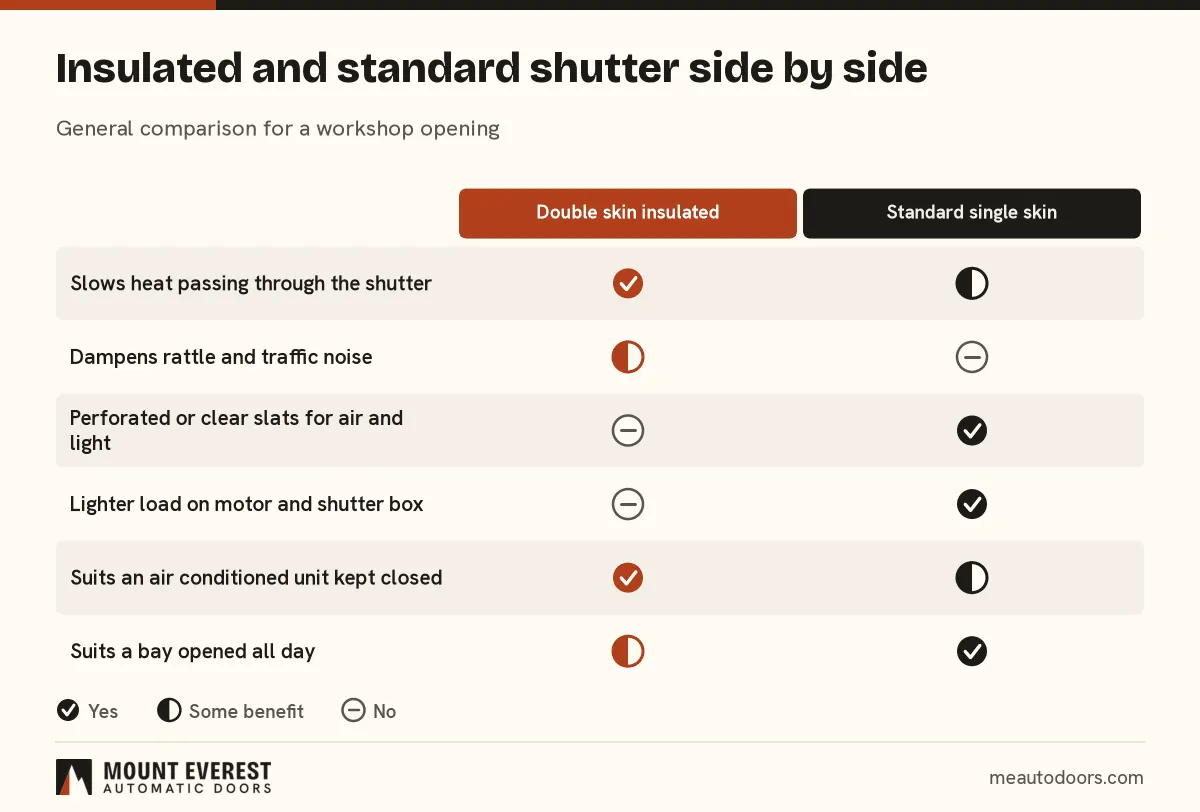
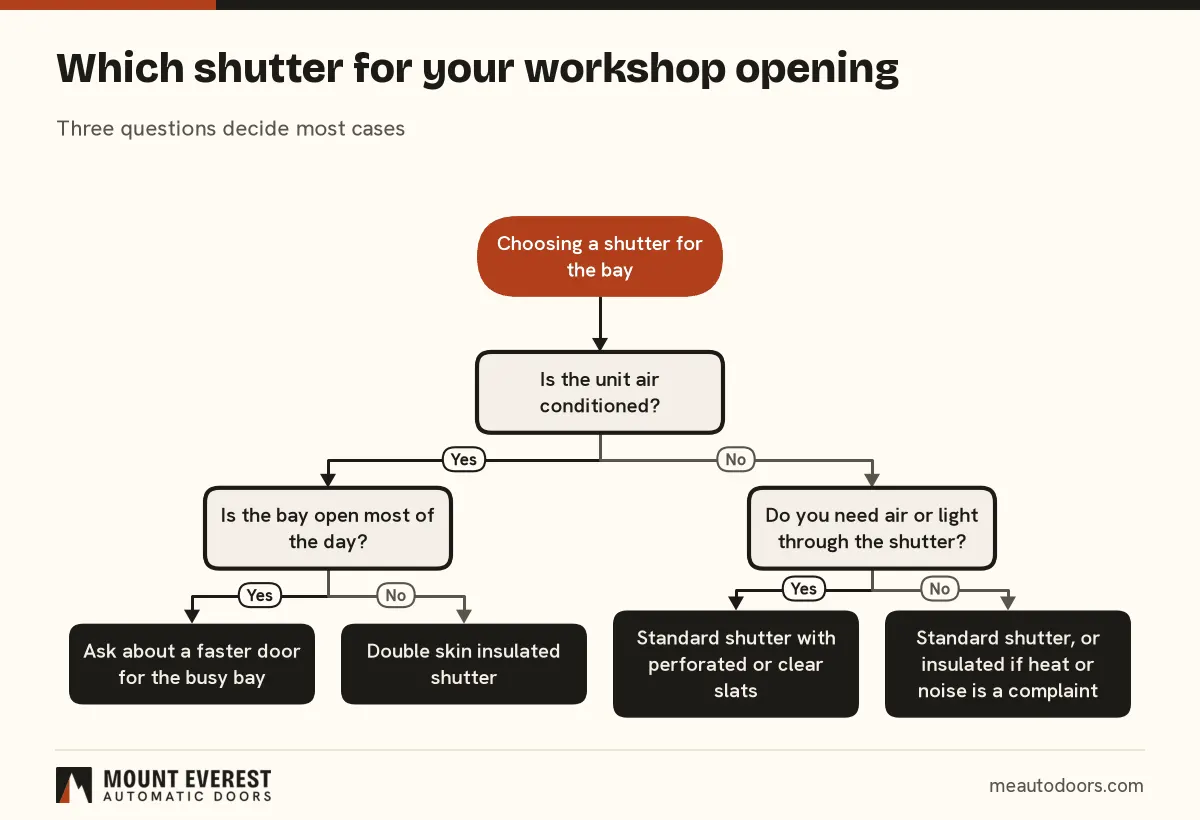
Short answer: Choose an insulated double skin shutter when the unit is air conditioned and the shutter stays closed for long hours, or when noise is a complaint. Choose a standard shutter when the bay is open most of the day, when you need perforated or clear slats for air and light, or when the load on the motor must stay low.
In short
- Insulation only pays back if the space behind the shutter is cooled and the shutter is shut for long periods.
- Gaps at the guides, the bottom bar and the shutter box let heat in whichever slat you pick, so check them too.
- Insulated slats are heavier. That affects the motor, the box size and the lintel space.
- A standard shutter with perforated or clear slats suits ventilated workshops and display openings.
- If the bay is opened all day, ask about a faster door instead of a better slat.
Why does this choice matter in Al Quoz?
Al Quoz is a mix of workshops, showrooms, stores and small factories, often in units with a single large opening facing the street. In a Dubai summer, that opening is the weakest point for both heat and noise. A shutter is not a wall, so the slat type and the fit around it decide how much of the outside gets in.
Many Al Quoz units are cooled by split or ducted air conditioning. If the shutter lets heat in, the cooling runs harder. In other units, such as a spray shop, a metal workshop or a vehicle bay, the opening is kept open for air and the shutter is only a night security barrier. Those two cases call for different shutters, and the mistake we see is buying one for the other.
For a villa window or a small opening, residential rolling shutters are a lighter option. The same questions apply in nearby Ras Al Khor and in Dubai Investments Park, where large industrial units share the same sun and sand.
What is the difference between an insulated and a standard shutter?
An insulated shutter is made of double skin slats with a foam core, which slows heat moving through the slat. A standard shutter uses a single skin slat, which is lighter and easier to move but conducts heat more freely.
Our page on double skin insulated rolling shutters covers the product. The wider double skin insulated doors service page covers the range, and automatic rolling shutters covers the standard type. Our FAQ on insulated shutter against normal shutter gives the short version of the same point.
How much heat does insulation actually save?
It depends on three things: how long the shutter is closed, whether the space behind it is cooled, and how well it seals. Without those, insulation does little. We do not quote a figure because the result differs unit by unit.
Think of the shutter as one part of a chain. Sun hits the outside slats, heat moves through the slat, and the air inside warms. An insulated slat slows the middle step. But heat also comes in around the edges. The guides on each side, the gap at the bottom bar and the shutter box above are all places where warm air or dust gets in. Slat choice cannot fix a poor fit.
- Is the space cooled, and for how many hours a day is the shutter closed?
- Does the shutter face the afternoon sun?
- Are the guides straight and the bottom seal in good order?
- Is there a gap above the shutter box that lets in warm air?
- Do you open the shutter many times a day, letting out cool air each time?
If your answer to the last question is yes, the shutter is only part of the issue. A shutter that opens and closes dozens of times a day suits a door built for speed. See the page on high speed doors.
Will an insulated shutter be quieter?
A little, on the shutter itself. A foam core and a double skin damp the rattle of the slats and the drumming of rain or wind, so a workshop beside a noisy yard may notice the difference. It will not block a forklift or a compressor, because the opening is still much weaker than a wall.
The bigger noise sources are usually the motor, the guides and the bottom bar hitting the ground. Those are fixed by correct installation and by service, not by the slat. If the noise is new, treat it as a fault. Our guide to industrial door and gate breakdowns in Dubai lists the symptoms in order.
What about running cost?
Running cost has three parts: the electricity for cooling, the motor effort, and the maintenance. Insulation can lower the first for a cooled unit and raise the second slightly, because heavier slats need a stronger motor and more careful balance. The third is the same for both types if the shutter is serviced.
| Cost item | Insulated shutter | Standard shutter |
|---|---|---|
| Cooling load of the unit | Can be lower when closed for long hours | Higher on a sun facing opening |
| Motor and shutter box | Heavier slats, stronger motor and larger box | Lighter slats, smaller box |
| Service | Same routine: guides, bottom bar, motor, limits | Same routine |
| Damage repair | A dented double skin slat is replaced as a unit | A bent single skin slat is replaced or straightened |
A site visit gives the real figure for your opening, because the lintel height, the box space and the existing motor all change the answer.
When should a workshop pick a standard shutter?
Pick standard when the bay is open most of the day, when air and light matter, or when the budget for the motor and structure is tight. A perforated or see through slat lets air through when you are working and still closes the opening at night. Our FAQ on choosing between a solid and a see through shutter for an Al Quoz unit walks through that choice.
Whatever you pick, sand matters. Dust in the guides makes any shutter noisy and slow. See the FAQ on cleaning rolling shutters in Dubai.
What should we check before ordering?
- The clear width and height of the opening, and the headroom above it for the box.
- Whether the lintel can carry the weight of a heavier shutter and its box.
- The power supply near the opening, and where the control box will go.
- Whether the opening faces the sun in the afternoon.
- Any landlord, industrial area or building rules for changing the opening.
- Whether the existing shutter is manual, and whether you want it motorised.
How does a site visit for a shutter work?
A technician looks at the opening before anyone quotes. The visit is short and follows the same order each time.
- Measure the clear width and height, and the space above the opening.
- Check the lintel, the side walls and the floor where the guides and the bottom bar meet.
- Look at the existing shutter, its box, the motor and the power point.
- Ask how the unit is used: cooled or not, how often the bay opens, what traffic passes.
- Give a written offer that names the slat type, the motor and what the visit covers.
The site visit is free, and the written offer comes after it.
See a shutter job in Al Quoz
Project
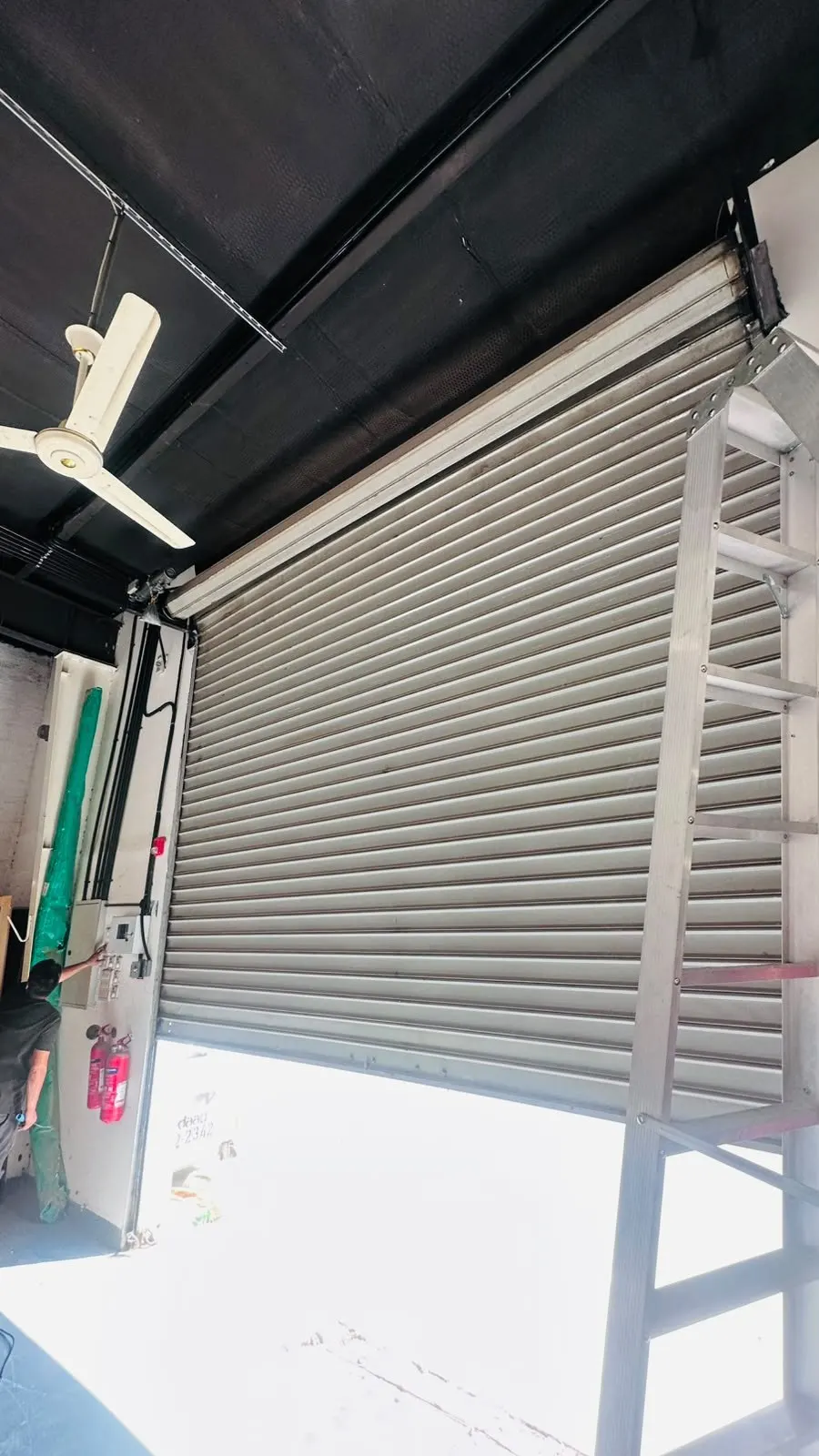
Manual rolling shutter converted to automatic in Al Quoz, Dubai
This unit has a tubular motor at the top of the shutter and a wall mounted control box beside the opening. See the full project record. For more on the area, read automatic doors and rolling shutters for Al Quoz warehouses.
To see how a shutter and its box are set out for a new job, our page on rolling shutter doors lists the options.
Frequently asked questions
Is a double skin shutter worth it for an uncooled workshop?
Often not for heat, because there is no cooled air to protect. It can still help with noise and with a more solid feel. If the workshop is ventilated and open during the day, a standard or perforated shutter is usually the better fit, and the saving can go into good guides and service.
Can I swap my old shutter for an insulated one in the same opening?
Sometimes. Insulated slats are heavier and the shutter box is larger, so the lintel, the headroom and the guides must be checked. Send photos of the opening and the existing box, with measurements, and we will tell you what can be reused.
Will insulation stop the sand getting in?
No. Sand comes in at the guides, the bottom bar and any gaps. Good brush seals, straight guides and regular cleaning do the work. Insulation is about heat passing through the slat, not about sealing the edges.
Does an insulated shutter need a stronger motor?
Usually, because the slats weigh more. The motor must be sized for the weight and the width, so give your supplier the real dimensions. An undersized motor runs hot and wears out early, particularly in summer.
Can I add a pass door to a big shutter?
Many shutters can be fitted with a small side door or an additional access, but the design depends on the shutter and the opening. Ask at the survey, and use the pass door for people so the big shutter stays shut and keeps the cool in.
Can I add insulation to a standard shutter I already have?
Not in a way we would recommend. The insulation is part of the slat, so foam or film stuck onto a single skin slat adds weight to a balanced shutter and can strain the motor. Shading the opening, sealing the gaps at the guides and keeping the shutter closed while the unit is cooled usually help more.
How often should a workshop shutter be serviced?
A periodic check suits most units, and busier or sandier sites need more attention. Ask for a written list of what each visit covers. Our maintenance contract page explains how a visit works.
Send us the details and we will advise
What to send us
- A photo of the opening from outside and from inside, showing the shutter box
- Clear width and height of the opening, and the headroom above it
- The current shutter type: manual or motorised, and the motor brand if you can see it
- Whether the unit is air conditioned, and whether the bay is open most of the day
- Your unit location, such as Al Quoz or Ras Al Khor
Call or WhatsApp +971 50 494 8667, ask for a written offer on the quote form, send photos through the photo page, or book a visit on the site visit page. Mount Everest Automatic Doors covers Dubai first and books jobs in the other emirates by appointment.
Want this done properly?
Send a photo of your door or gate and we will tell you what we see.